
March on Washington Part II

A few take away thoughts from the few days spent in DC:

Although no elected representatives or staff voiced it, there is some sense of health care reform fatigue among Capitol Hill staffers.  Since our issues are not major changes to the bill, we had a more receptive audience.

Senator Kerry gave the most impassioned defense of health care reform of all Senators we heard from at NAHC’s Senate Breakfast.  He commended provider input and acknowledged that much of the difficult work is yet to be done. His speech in full is on our You Tube Channel.

Congressman McGovern remains among the greatest supporters of home care in the US Congress. He is so, because home care leaders in his district got to him right after his first election and passage of the BBA of 1997.   His unwavering support shows the power of relationship building and the value of developing support among newly elected representatives.

It was great that we were able to meet Senator Scott Brown if only to start educating him about what we do. See previous comment above.

There are many opportunities for home care in the reform bill; but is going to be up to us to make sure that they come to pass.  All hands are going to be needed on deck.

Get involved and stay involved.  Your voice is going to be needed.

– Pat Kelleher

Return to www.thinkhomecare.org.
March on Washington Part I

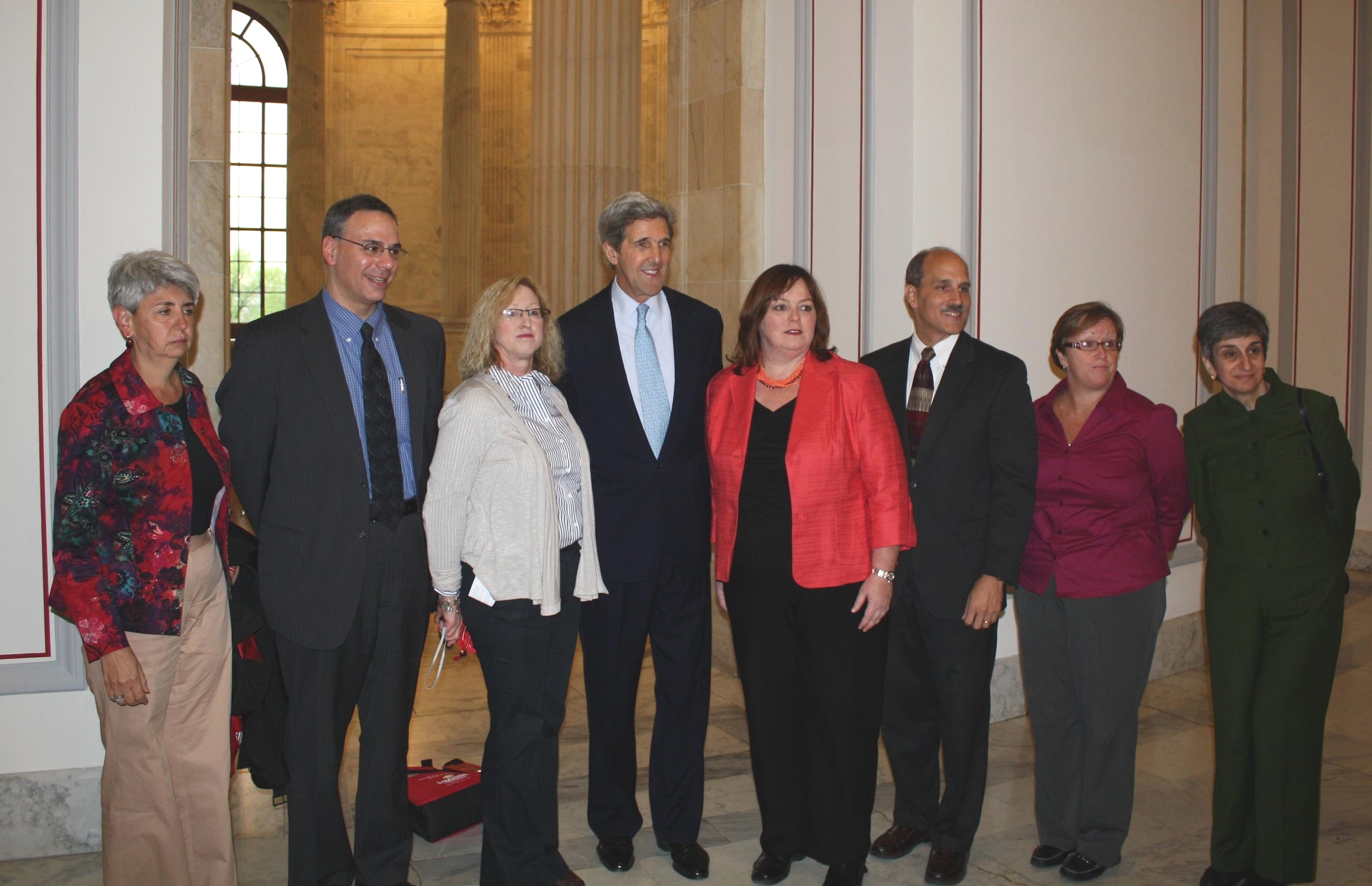
Home Care Alliance members With Senator John Kerry

The Home Care Alliance was pleased to join members from Hebrew Senior Life Homehealth  Care, Overlook VNA, Partners Home Care, VNA of Boston and VNA of Middlesex East in Washington, DC this week to make sure that as health reform’s changes move forward in the coming years, home care and hospice are treated fairly and our patients’ interests are protected.

The days included briefings with staff from 8 of our 11 Congressional offices and a Senate breakfast briefing that featured remarks from Senators Susan Collins, John Kerry (see photo with Alliance delegation) , Chuck Grassley, Russ Feingold,  Ben Cardin, Jeff Merkley, Amy Klobuchar, and John Thune.  Senator Scott Brown and his staff also met with some members of the delegation.

Rey Spadoni, Executive Director VNA of Boston with Senator Scott Brown

More will be written soon on these meetings and the message delivered; and some video and pictures will be posted to our Facebook page.

The member agencies that took the time and expense to travel to Washington and speak to home care’s issues deserve the appreciation of all Home Care Alliance members.

—-  Pat Kelleher

Care Transitions And Home Care

For the many who have expressed interest, what follows is an update from the perspective of home care and the Home Care Alliance on Care Transitions – and the intersection with STARR efforts in this state.   A number of members are already involved in many of these efforts, but more input is welcome and needed.

The Alliance’s Care Transitions Task Force has met several times to continue work on a document we are calling our “Opt In” framework:   “Optimum Performance Standards for Transferring Patients To and From Home Health Care.” We have a good first draft and various pieces are being rewritten by Task Force members.     This will be a tool we provide to member agencies;  but it will also serve as a framework for partner providers to help them understand what they can expect when making a referral to home health.  This group will meet again in Brockton on April 27th at 11am.

Two additional efforts are underway in relation to the IHI STAAR project.  IHI is working with their project team on a Field Guide for Home Health – which will mirror those that have already been published for Physician offices and Skilled Nursing Facilities. These Guides – which I am happy to forward to anyone would like them – focus on encouraging use of evidence based best practices in the area of readmission reductions.   Some of these practices  – obviously  – have to do to with what happens during  “handovers.”  We have had a call with IHI on the outline for home health,  and several members have agreed to spend some time with IHI in Cambridge on either April 29 or 30 on actually beginning to draft the full document. Cheryl Pacella of Hebrew Senior Life HomeHealth Care is playing a lead role in facilitating this.

Additionally, the STARR project is looking at reducing readmissions through an ‘Enhanced Admission” tool. Given that our agency members on STARR teams – as well as those of us on the STAAR Steering Committee – have identified that hospitals may NOT be appropriately identifying who needs and could benefit from home health care, the team is looking at potentially modifying a QIO tool developed as part of HHQI to recommend be used as part of a process for screening all – or high risk patients – for home care.  We are needing to do a thorough industry review of this tool and make recommendations to IHI.  This will eventually be discussed on a STAAR home health call.  These calls are now open to any  interested agency (see previous post to this blog.)

Finally, one of the first action items from the state’s Care Transitions Plan will be to revise the three page discharge form to meet information needs of sending and receiving health care entities.   A Task Force with HCA representation will start meeting this month. As available, we will share for input with  this group.

These are all ambitious projects that can not be done without member input.  If you are not yet involved, it’s not too late to be so.  Just reply here or send me an email.     Thank you to all who have been supporting these efforts.

Pat Kelleher

Return to www.thinkhomecare.org.

STAAR Project and Home Health

Mid way through the first year of a multi-year project, the state STAAR (STate Action on Avoidable Rehospitalizations) Project has begun looking more closely – at both the project and collaborative team level – at the role of home health care in readmission reduction. The project has recently added a special “Learning Community” for home health agencies and office practices that convenes for one hour a month.   Any home agency, regardless of participation in STAAR, is welcome on these calls.  Call-in information is at the bottom of this post.

Additionally, the STAAR project is bringing to light the possible underutlization of home health services.  One effort to address this may be incorporated into an “enhanced admission” best practice for all STARR hospitals that will begin the process of assessing home-going needs upon admission.   Members of the Home Care Alliance are working with IHI on a discharge criteria tool to be embedded in the enhanced assessment to screen for appropriatenss for home care.

The STAAR teams is also working on a guide for “Creating an Ideal Transition to a Home Health Agency”  that will highlight practices,  tools and case studies of promising changes.

The STAAR project represents a significant step forward in using cross continuum teams to make a real difference in readmission rates and in the projects own words to “create new public and professional norms in which avoidable emergency department visits and avoidable rehospitalizations are seen as system defects.”

Whether you are directly involved in a community collaborative or not, every home health agency is invested in this project’s work and outcomes.

Learning Community Calls for Home Health/Office Practice

Wednesday, April 7 from 1:00 – 2:00 PM, ET
Wednesday, May 5 from 1:00 – 2:00 PM, ET
Wednesday, June 2 from 1:00 – 2:00 PM, ET

To WebEx Website: http://ihi.webex.com

Call In Number: 866-469-3239
Session Number: 352 310 006

Session Name: STAAR OP & HH Learning Community Call

Health Care Reform and Home Care: What We Know Today

On Sunday, March 21st the US House of Representatives passed historic Health Care Reform Legislation.   The bill that passed is that which emerged from the Senate Finance Committee and that passed the Senate at the end of 2009.   As has previously been reported,  the Senate version of reform has been – for home care – less damaging than bills that had previously passed the House. While indications are that there may be some changes to Medicare provisions in the “reconciliation” bill being debated this week in the Senate, there is no indication that there will be changes to the home care language.  What we should expect for home care will be:

• A delayed and phased approach to rebasing of home health payments (rebasing would begin in 2014 and be phased in over four years, as compared with the House’s proposal of complete rebasing in 2011);

• Rejection of the Medicare Payment Advisory Commission’s proposed acceleration to 2010 of the 2011 case-mix creep adjustment;

• Preservation of the full market basket update for 2010, with 1 percentage point reductions off the market basket in 2011, 2012, and 2013

• Reinstatement of the rural payment differential (add-on) at 3 percent from April 1, 2010 until Jan. 2, 2016.

The federal long term care program – the CLASS act – is in,  as are demonstration and pilot programs for providing chronic care management, transitions in care, and post-acute care management.  All of these should involve home care.

Additionally, effective in 2014, employers of more than 50 people will be required either to provide coverage or pay a penalty for not offering health insurance to employees. (It is unclear at this point how federal insurance mandates will be handled in relation to the Massachusetts mandates already in place.)

The National Association for Home Care has called the bill “a combination of new opportunities for home care — and threats to the viability of the home health services community.”

With many of the home care cuts  delayed, and demonstration projects to help shape, we will need every voice in Washington to make sure our issues continue to be heard above the continuing health care reform roar.

What’s Next for Health Care Reform in Massachusetts?

Three days of hearings by the Mass Division of Health Care Finance & Policy (DHCFP) on Health Care Cost Trends in Massachusetts started with a bang as the Attorney General of Massachusetts Martha Coakley released and testified on a report from her office detailing how clout and market share and not quality contribute to wide variation in reimbursement and drive prices up in Massachusetts.

Also being considered and discussed by state officials are data on payment variation submitted by insurers – such as these from Harvard Pilgrim Health Care, which also appeared in the Boston Globe.

At stake in the discussions are some very immediate proposals by the Governor to expand the authority of the state’s Division of Insurance to approve or deny health insurance premium increases.  Longer term, these hearings are about degree of regulatory oversight of premium and rate setting, urgency and viability of global payments and/or systemic payment reform and ultimately, perhaps, the success or failure of the Massachusetts  universal health insurance law.

For those who are interested in what may shape health care reform in Massachusetts for the near future, the event is available through Live Streaming: http://vpc.umb.edu:8080/ramgen/broadcast/live.rm

Or view the powerpoint presentations as they are posted at DHCFP website.

Otherwise stay tuned.

Return to www.thinkhomecare.org.

Family Caregiver and Care Transitions Resources In One Place

The CHAMP (Collaboration for Homecare Advances in Management and Practice) team has become a good industry go-to site for comprehensive evidence based practices and tools.  CHAMP has just released free resources and downloadable tools under the topic: family caregivers.  Some of the tools on the CHAMP website were developed in New York as part of the Next Step in Care project.  This comprehensive Care Transitions website includes family and agency guides and checklists on everything from medication management  to HIPAA – many are in English, Russian, Spanish and Chinese.  All free of charge to interested users.

Home Care, Palliative Care and Advanced Illness Management

The CHAMP program at the Center for Home Care Policy & Research of the Visiting Nurse Service of New York has developed a useful website that consolidates many evidence based tools and studies aimed at promoting high quality home based care.   In a new posting on their community blog, Dr Eric Widera of the Division of Geriatrics at UCSF discusses the power home care agencies have to provide innovative care that can integrate the palliation of symptoms, care coordination and advance care planning earlier in a patient’s disease trajectory. Included in his discussion of this timely issue – given the STAAR and End of Life Care Expert Panel projects in Massachusetts – is a link to CHAMP’s Evidence Brief on Advanced Illness Management.   Does this look like something your agency is already doing? Or could be? Comments welcome.

Care Transitions as a Reform Strategy

A key tenet of the Massachusetts Quality Improvement Initiative is an  efforts to improve the flow of patients – and information – from one health care setting to another.  The state’s broad plan is laid out in it’s recently released “Strategic Plan for Care Transitions.” Care transitions are an obvious choice as it is an area in which data indicate Massachusetts can do better.  The federal AHRQ 2008 state rankings place Massachusetts seventh overall for health system performance, but 33rd in avoidable hospital admissions and costs.    For your consideration:  How can home health care contribute to an improved care transitions infrastructure?  In terms of medication reconciliation?   Chronic care symptom management? Screening for readmission risk?    The state’s attention to this issue, can be home health’s opportunity to shine.  Your comments and ideas are welcome.

Cost Containment Roadmap Completed

The Massachusetts Health Care Quality and Cost Council, which is a public entity responsible for setting quality and cost targets for the Commonwealth, has issued the final version of its Roadmap to Cost Containment. The Roadmap outlines 11 key strategies to allow the Commonwealth to meet its goals of sustainably containing cost growth in health care as well as improving the quality of health care.