
“That’s Democracy”

Anyone interested in a little insight into CMS under Dr. Don Berwick and what the legacy of  his short tenure might be can find a lot to consider in the online Health Affairs post:  “Now Departed From The Centers For Medicare And Medicaid Services…” written by Harris Meyer.    The article looks at Berwick’s efforts to both transform the health care delivery system, as well as the CMS agency and the 5,400 people it employs.    “We’re working on the agency culture and habits,” he said in an interview between meetings.  “We’re seeking boundarylessness, speed and agility, unconditional teamwork, innovation, and customer focus. ”  All indications are that the large bureaucracy was beginning to respond.

Interestingly, Berwick’s “that’s democracy” quote comes not in response to the partisanship in Washington DC that laid ruin to any chance he had at a permanent appointment.  Berwick used the phrase in reflecting on the outpouring of (mostly negative) comments received at CMS from health care stakeholders with the release of his preliminary proposal on Medicare Accountable Care Organizations.  “What happened is what should have happened,” he said. “We took our best shot, and smarter people than we are responded. That’s democracy.”

Democracy indeed. Read it for yourself and decide.
More News on Care Transitions Funding

Despite tremendous national interest, the new CMS Center for Medicare and Medicaid Innovation (CMMI) has  funded only seven applicants to date under its new Care Transitions project.   While CMS will not say how many applications they received and rejected in the first round, or how many are pending review, information is slowly coming to light about the funded projects.  For entities still looking to apply – and CMMI is clear that they continue to want applicants!! – the information is potentially instructive.

One of the funded sites – in Greater Cincinnati – shared on the Medicaring blog (hosted by the non profit Altarum Institute) that they plan to serve about 5400 beneficiaries and save about $1 million using what they call a “modified Coleman Model.”   The same blog in a slightly earlier post ran an interesting piece on developing a “blended” per person rate as required by the Section 3026 budget worksheet.

Those who want more detail on what has been funded, can find a summary of projects on the CMS Care Transitions project website.  Two threads common to all projects and stressed on a call with awardees has been that  1) funded sites have some care transitions experience with a specific model and 2)  multiple hospital partners are involved.  In the case of the latter, CMS wants to see actual agreements in place, not just letters of support.

It’s All About Innovation

The Centers for Medicare and Medicare Services (CMS) announced yesterday that they are offering $1 billion in grants to providers and payers who propose “the most compelling new ideas to deliver better health, improved care and lower costs” for the Medicare, Medicaid and CHIP populations. CMS noted that priority will be given to projects that can begin within six months after the award is granted.

CMS has identified three primary objectives of the Innovation Challenge funding:

  1. Engage a wide variety of innovation partners and test new care delivery and payment models that promote better care, better health, and reduced costs;
  2. Identify new models of workforce development, deployment, education, and training that support new models; and,
  3. Support innovators who can rapidly deploy (within six months of award) through new ventures or expansion of efforts to new populations, in conjunction with other private and public sector partners.

The Home Care Alliance is hosting our own members Innovation Showcase on December 7th at the John F. Kennedy Library. At this event, seven member agencies will present their successful work in agency transformation in areas of care transitions, readmissions reductions,  end of life care,  and more.   Senator President Therese Murray will be one of the invited guest speakers.

Join us on December 7th and be inspired.

Letters of Intent for the CMS program are due December 19th.

A Challenge to Home Care

Interesting and at least a bit encouraging, the CMS Director Don Berwick references home health as an essential part of a coordinated, seamless, patient centered care team in his October 20th, editorial in the New England Journal of Medicine (“Making  Good on ACO’s Promise). But, Dr Berwick leaves home health out of the definition of what will be required of applying entities to become Medicare’s first ACOs.  Dr Berwick presents  a vision in which Medicare beneficiaries “should find their care experience enhanced by a program that supports providers in engaging with their patients to deliver on the three-part aim: better care for individuals, better health for populations, and lower cost growth through improvements in care.”

Clearly Dr Berwick’s  vision is one that we all of share.  “Coordinated care,” he writes, ” is meant to allow providers to break away from the tyranny of the 15-minute visit, instill a renewed sense of collegiality, and return to the type of medicine that patients and families want.”  In this brave new world of coordination and collegiality, it will still be up to home care  to “sell” these organizing entities that home care has long understood and practiced patient centeredness, and that we have experience to spare and to share.

The Alliance is committed to helping us rise to Dr Berwick’s challlenge.

Find a full copy of the rule, here.


CLASS Act – Over Before it’s Begun

Once again, the needs of an aging nation in terms of support for long term care have been pushed aside with HHS Secretary Kathleen Sibelius’ announcement that the Obama Administration will not proceed with plans to implement a federally coordinated, voluntary national long term care insurance plan – known as the CLASS act

According to today’s Wall Street Journal, HHS officials gave up after “actuaries spent 19 months attempting to design a voluntary long-term care insurance program that met the requirements of the law.”  That called for making sure the program would remain fiscally solvent and pay for itself for at least 75 years.

Although the Class Act provision is little linked to the Affordable Care Act provision around providing basic health insurance universally, its  demise has inched open further the door to those who seeking to dismantle all of ACA piece by piece.   Senate Minority Leader Mitch McConnell (R., Ky.) said. “It is worth remembering that the Class Act is only one of the unwise, unsustainable components of an unwise, unsustainable law.”

Just what is unwise and unsustainable in your opinion: providing basic coverage and seeking a collective and shared solution to an aging society?   Or doing nothing?

Blue Cross AQC Contract Examined

An article in this week’s New England Journal of Medicine takes an interesting look at the Blue Cross Blue Shield of Massachusetts Alternative Quality Contract in terms of its impact on cost and quality and lessons it may hold for broader attempts to move towards global payment, locally and nationally.

The report – Health Care Spending and Quality in Year 1 of the Alternative Quality Contract – was compiled by researchers at the Harvard Medical School, the Heller School and Boston University. According to the report the AQC contains three distinguishing features.  First, physician groups, in some cases together with a hospital, enter into 5-year global budget contracts (rather than standard 1-year contracts).   Second, AQC groups are eligible for pay-for-performance bonuses up to 10% of their budget, with performance measures of ambulatory care and hospital care each contributing to half of the calculation of the bonus. Third, AQC groups receive technical support from BCBS, including reports on spending, utilization, and quality, to assist them in managing their budget and improving quality.

At present, the authors report, there are 321 PCP practices and more than 4000 physicians in the AQC.   The very general findings:

  • AQC was associated with modestly lower medical spending and improved quality in the first year after implementation.
  •  AQC quality bonuses are much higher than those in most pay-for-performance programs in the United States, since they apply to the entire global budget rather than to physician services alone or PCP services alone.
  • Procedures, imaging, and testing accounted for more than 80% of the savings. Savings derived largely from less spending on facility services in the outpatient setting. There were no significant changes in spending for inpatient care or for physician services.

The question raised is: are savings at least for this non Medicare population more in “shifting outpatient care to providers who charged lower fees” than in behavior change?  If so, what lessens are here for broader global payment models, especially those that involve Medciare and Medicaid?


Cong Markey Briefs Health Care On Debt Ceiling Discussions

Yesterday, Congressman Edward Markey conducted a briefing for members  of the health care and health research communities on the debt ceiling discussions and the possible impact on these sectors going forward.   Although the Super Committee has received a significant amount of the attention, the debt discussions will actually occur in three steps.

The first step will include a cut of $900 billion. These cuts must be effective on 10/1/2011. Medicare and Medicaid cannot be included in this first cut, but all other federal spending including defense and non defense can be considered.

Step 2 is the Super Committee, comprised of six Senators and Representatives. The budget target for this Committee is $1.2 trillion.  Their work must be done by Sept 23rd and if recommendations are made, must be voted on by Dec 23rd.  The bring a proposal forward will require 7 or the 12 votes.  In Senate, a simple majority vote will be needed to pass.

According to Markey, this group “will go from 0 to 60 miles per hour” to meet the September 23 deadline and for this group “everything is on the table.”    This group has broad latitude to propose changes in benefits or  program design in terms of federal entitlements, including Medicare and Medicaid benefits and program design;  eligibility and contributions to Social Security;  defense spending, tax rates, “loopholes”  and contributions, etc.  Markey indicated that all of the Republican appointees have pledged to support no new revenues, which will make this Committee’s work more difficult.

Should the Super Committee not reach consensus, the process will move to Step 3, which would be a an automatic cut on 10/1/13 of $1.2 trillion in spending, 50% of which would come from “security” and 50% from non security spending.  Under this scenario, the sole restriction is that Medicare cuts would be set at 2%.

Congressman Markey engaged the group in discussing:

What is you message to the Super Committee?

What would you recommend that Super Committee members do if there are no revenues and only cuts to achieve the goal?  Is moving to Step 3 preferable to this scenario?

Is a Step 3, i.e. 2% cut in Medicare in Oct 2013 sustainable?

Question to Home Care:   What is your message to Congress on this?

Home Care Nurses Speak Up in Washington

As the “debate” continues in Washington over the debt ceiling and capping government spending, home care nurses added their voices to those speaking against propoals that would cut Medicare funding and impose co-payments. What is at stake are proposals by:  1) The National Commission on Fiscal Responsibility and Reform that would impose a uniform 20 percent co-pay and a uniform overall deductible of $550 for all Medicare services combined, including home health care;  or 2) the Medicare Payment Advisory Commission (MedPAC) which recommended a home health copay (as much as $150 per episode) for episodes not preceded by a hospital or nursing home stay as a means to encourage beneficiaries to control utilization of care.

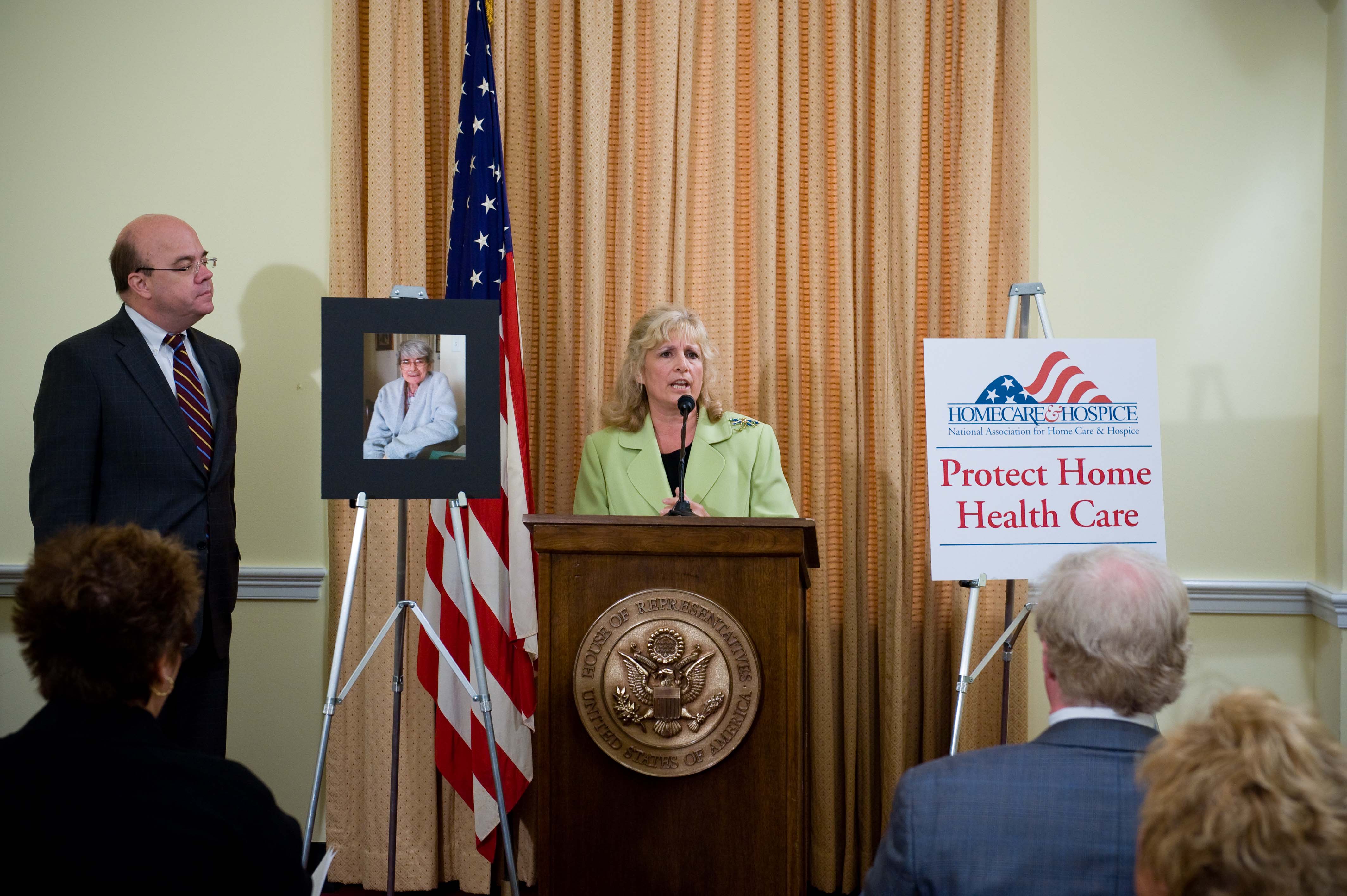
Congressman James P McGovern (D-MA) a long time champion of home care spoke to the nurses saying:  “It is important that members of Congress understand that you are part of the solution,” McGovern said. McGovern said that keeping a person at home is cheaper and patients are ultimately happier.

Home Care Alliance Board member Elaine Stephens, of Overlook VNA,  represented Massachusetts at the nurses rally that also included remarks from National Association for Home Care President Val Halamandaris and Max Richtman, executive vice president and acting CEO, of the National Committee to Preserve Social Security and Medicare.

To send a message to Congress to keep home care cuts out of debt ceiling discussions, go to the Alliance’s advocacy page.

Mass State Website Looks To Add Home Health Compare Data

At its July meeting, the Massachusetts Quality and Cost Council (QCC) put on its agenda for the coming year a plan to place CMS  Home Health Compare data on its consumer education website.  The state’s My Health Care Options website was established by the Mass QCC as a resource for patients and families looking to make informed health care choices. The majority of the data on the site to date have been on hospital and medical practice quality and costs, with a new update of these data posted in January 2011.

Home health care was identified in the QCC’s Three Year Reporting Pla as “a vital service to the aging population and  an important area of information for consumers.”  The Council is exploring options to download the CMS data in a consumer friendly format, as opposed to simply placing a CMS website link.  The costs and feasibility of this are being reviewed prior to the Council’s next meeting.

Are consumers or other referral sources using CMS data now? Will  it get more visibility on the state’s website?  What are your thoughts?

Therapy Changes Clarified in PPS Rule

As part of the Home Health PPS Update for Calendar year 2012, CMS also made some minor technical changes to the therapy assessment language found in the prior PPS update for 2011.

Currently the regulation reads that the qualified therapist from each discipline must provide the therapy service and functionally reassess the patient…during the visit which would occur close to but before the 19th visit per the plan of care.  The regulation will now read “…during the visit which would occur close to but no later than the 19th visit per the plan of care.

Additionally, CMS clarified when occupational therapy is considered a “dependent” service and when it is considered a “qualifying” service.

It is a dependent service when the beneficiary initially qualifies for the home health benefit beginning the first episode of care.  That is, the beneficiary’s eligibility for the home health benefit is established by virtue of a need for intermittent skilled nursing, speech language pathology or physical therapy. Then they are entitled to SN, PT, ST, HHA, MSW and OT.

When occupational therapy is the sole skilled service being provided in subsequent episodes after the benefit has been established it is considered a “qualifying service.”