
Chronic Care Management And Home Care

Yesterday more than 40 Alliance members participated in a workshop on making the business care for home care to be at the enter of efforts to introduce better management of chronic illness to the US health care system.   Beth Hennessey of Baptist Home Care provided the agency template for matching the core competencies of home care to the policy and programmatic changes that are envisioned in federal health care insurance and delivery system reform.

One take away message is that Massachusetts may see opportunities in this area even quicker than the rest of the country as this state is moving into Phase II of reform (system realignment) while most other states are still on Phase I (universal coverage).   An immediate challenge to home care to deliver services in a new and different way may well present itself when the state releases its RFP – this spring or summer – for a broad Medical Home pilot.

All home care agencies should be familiar with the state’s plans – as described in their Patient Centered Medical Home Framework for Design and Implementation. Help physicians to see how a new home care partnership can make a medical home work.

– Pat Kelleher

Return to www.thinkhomecare.org.

Help HCA Gain Support for Budget Priorities in the House

The Home Care Alliance has two major budget priorities in the House and the push for gaining support from state representatives has begun!

Please visit our Legislative Action Center and send a pre-written message to your state representative. All you have to do is fill out the form with your contact information, click “submit” and the message you are sending will pop up with the legislator who will receive your email message. It takes less than a minute to help HCA gain vital support for amendments to:

  • Restore MassHealth home nursing rates past 60-days of care (House Amendment #135 submitted by Rep. Joseph Driscoll) and
  • Establish a tele-health demonstration project (House Amendment #289 submitted by Rep. Alice Wolf)

Last year, more than 1,000 email messages were sent during the House and Senate budget debates and you can help us beat that this year!

You can also call your state representative using our fact sheet as a guide to verbally ask for their support of HCA amendments. If you’re unsure who your state representative is, click here to find out.

Return to www.thinkhomecare.org.

March on Washington Part II

A few take away thoughts from the few days spent in DC:

Although no elected representatives or staff voiced it, there is some sense of health care reform fatigue among Capitol Hill staffers.  Since our issues are not major changes to the bill, we had a more receptive audience.

Senator Kerry gave the most impassioned defense of health care reform of all Senators we heard from at NAHC’s Senate Breakfast.  He commended provider input and acknowledged that much of the difficult work is yet to be done. His speech in full is on our You Tube Channel.

Congressman McGovern remains among the greatest supporters of home care in the US Congress. He is so, because home care leaders in his district got to him right after his first election and passage of the BBA of 1997.   His unwavering support shows the power of relationship building and the value of developing support among newly elected representatives.

It was great that we were able to meet Senator Scott Brown if only to start educating him about what we do. See previous comment above.

There are many opportunities for home care in the reform bill; but is going to be up to us to make sure that they come to pass.  All hands are going to be needed on deck.

Get involved and stay involved.  Your voice is going to be needed.

– Pat Kelleher

Return to www.thinkhomecare.org.
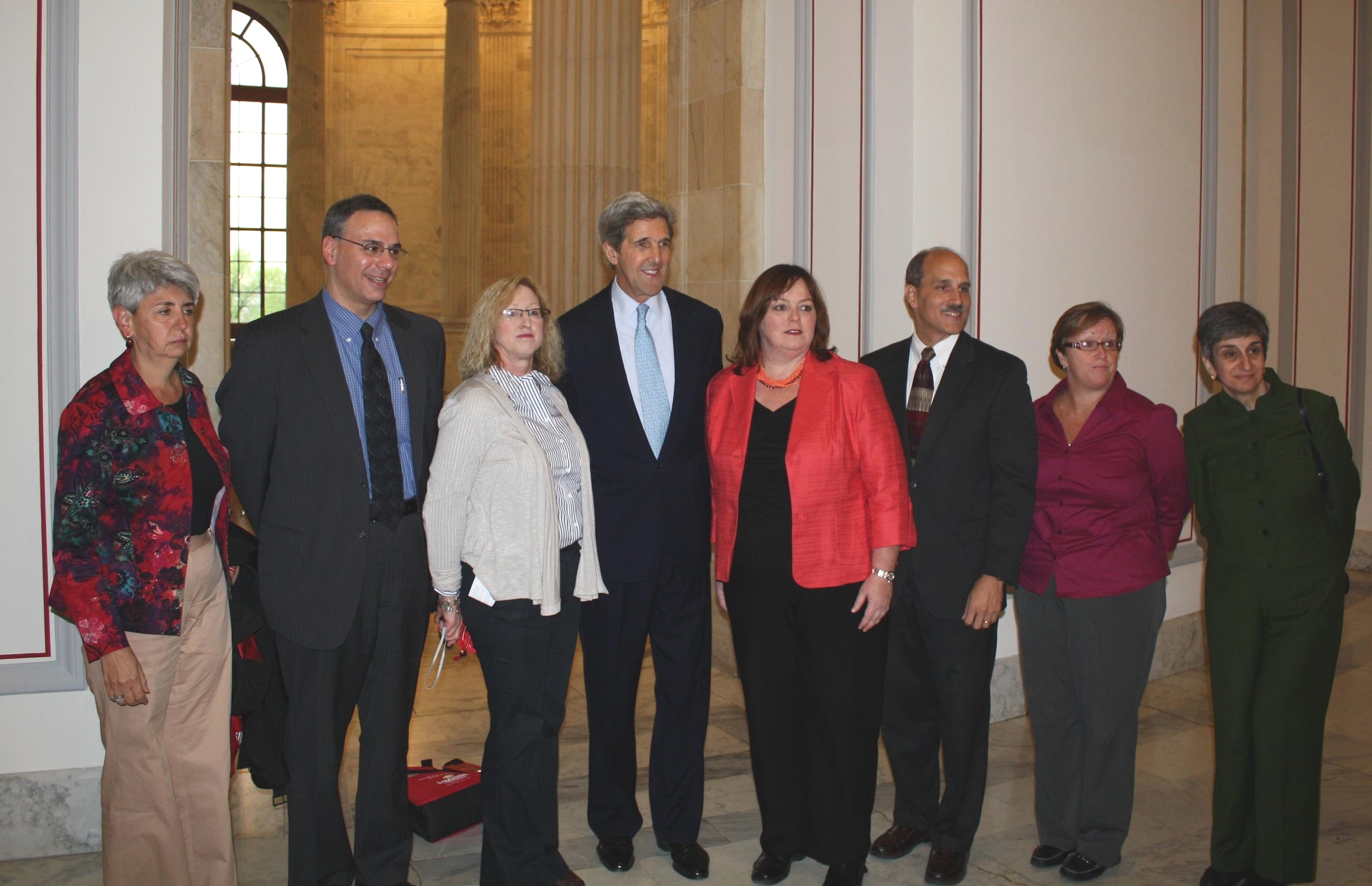
March on Washington Part I

Home Care Alliance members With Senator John Kerry

The Home Care Alliance was pleased to join members from Hebrew Senior Life Homehealth  Care, Overlook VNA, Partners Home Care, VNA of Boston and VNA of Middlesex East in Washington, DC this week to make sure that as health reform’s changes move forward in the coming years, home care and hospice are treated fairly and our patients’ interests are protected.

The days included briefings with staff from 8 of our 11 Congressional offices and a Senate breakfast briefing that featured remarks from Senators Susan Collins, John Kerry (see photo with Alliance delegation) , Chuck Grassley, Russ Feingold,  Ben Cardin, Jeff Merkley, Amy Klobuchar, and John Thune.  Senator Scott Brown and his staff also met with some members of the delegation.

Rey Spadoni, Executive Director VNA of Boston with Senator Scott Brown

More will be written soon on these meetings and the message delivered; and some video and pictures will be posted to our Facebook page.

The member agencies that took the time and expense to travel to Washington and speak to home care’s issues deserve the appreciation of all Home Care Alliance members.

—-  Pat Kelleher

Spring Conference Registration is Now Open

Registration for our Spring Conference at the Sturbridge Host Hotel in Sturbridge, MA is now open. To learn more about the conference, visit the conference web page where you can download the registration form or register online.

Return to www.thinkhomecare.org.

New OASIS-C Information on Wound Care

Medline’s recent article on Unraveling the Pressure Ulcer and Wound Care Sections of OASIS-C is available for download.  Other news & information regarding the new standards are available on our OASIS-C page.

Return to www.thinkhomecare.org.

March on Washington from Home

The Home Care Alliance will be in the nation’s capitol on April 11-13 for the NAHC “March on Washington.”

For those who cannot make it to Washington DC, you can still participate in the “March” by calling your federal representatives and asking for their support of home care. NAHC has made background information and recommendations available and the office information for the state’s federal legislators are below. Make the call or send an email from our Legislative Action Network!

Not sure who your elected officials are? Click here.

  • Congressman John Olver
    202-225-5335
  • Congressman Richard Neal
    202-225-5601
  • Congressman McGovern
    202-225-6101
  • Congresswoman Tsongas
    202-225-3411
  • Congressman Tierney
    202-225-8020
  • Congressman Barney Frank
    202-225-5931
  • Congressman Lynch
    202-225-8273
  • Congressman Capuano
    202-225-5111
  • Congressman Markey
    202-225-2836
  • Congressman Delahunt
    202-225-3111
  • Senator Brown
    202-224-4543
  • Senator Kerry
    202-224-2742

New CHAMP Courses in Geriatric & Pain Management

The Home Care Alliance is pleased to announce our partnership with CHAMP, an exciting new benefit for our members.  CHAMP Collaboration for Homecare Advances in Management and Practice is a unique national initiative designed to advance home care excellence for older people.  CHAMP’s web site www.champ-program.org is a one-stop resource for home care professionals and includes expert advice, downloadable practice tools, and online educational courses and activities all to be used for improving the quality of home-based patient care.

CHAMP currently offers two web-based courses for frontline home care managers: Geriatric Medication Management and Geriatric Pain Management.  These courses are designed to give managers the skills and tools they need to help their clinical team improve the quality of care for older home care patients.  Registration is now open for both courses scheduled to begin on April 26th.  Home Care Alliance receive a $40 discount, bringing the total cost per course to $109.

To learn more about the courses and to register online, click here or contact Thomas Bow, CHAMP Liaison, at 212-609-5767 or thomas.bow@vnsny.org.

Return to www.thinkhomecare.org.

Care Transitions And Home Care

For the many who have expressed interest, what follows is an update from the perspective of home care and the Home Care Alliance on Care Transitions – and the intersection with STARR efforts in this state.   A number of members are already involved in many of these efforts, but more input is welcome and needed.

The Alliance’s Care Transitions Task Force has met several times to continue work on a document we are calling our “Opt In” framework:   “Optimum Performance Standards for Transferring Patients To and From Home Health Care.” We have a good first draft and various pieces are being rewritten by Task Force members.     This will be a tool we provide to member agencies;  but it will also serve as a framework for partner providers to help them understand what they can expect when making a referral to home health.  This group will meet again in Brockton on April 27th at 11am.

Two additional efforts are underway in relation to the IHI STAAR project.  IHI is working with their project team on a Field Guide for Home Health – which will mirror those that have already been published for Physician offices and Skilled Nursing Facilities. These Guides – which I am happy to forward to anyone would like them – focus on encouraging use of evidence based best practices in the area of readmission reductions.   Some of these practices  – obviously  – have to do to with what happens during  “handovers.”  We have had a call with IHI on the outline for home health,  and several members have agreed to spend some time with IHI in Cambridge on either April 29 or 30 on actually beginning to draft the full document. Cheryl Pacella of Hebrew Senior Life HomeHealth Care is playing a lead role in facilitating this.

Additionally, the STARR project is looking at reducing readmissions through an ‘Enhanced Admission” tool. Given that our agency members on STARR teams – as well as those of us on the STAAR Steering Committee – have identified that hospitals may NOT be appropriately identifying who needs and could benefit from home health care, the team is looking at potentially modifying a QIO tool developed as part of HHQI to recommend be used as part of a process for screening all – or high risk patients – for home care.  We are needing to do a thorough industry review of this tool and make recommendations to IHI.  This will eventually be discussed on a STAAR home health call.  These calls are now open to any  interested agency (see previous post to this blog.)

Finally, one of the first action items from the state’s Care Transitions Plan will be to revise the three page discharge form to meet information needs of sending and receiving health care entities.   A Task Force with HCA representation will start meeting this month. As available, we will share for input with  this group.

These are all ambitious projects that can not be done without member input.  If you are not yet involved, it’s not too late to be so.  Just reply here or send me an email.     Thank you to all who have been supporting these efforts.

Pat Kelleher

Return to www.thinkhomecare.org.

STAAR Project and Home Health

Mid way through the first year of a multi-year project, the state STAAR (STate Action on Avoidable Rehospitalizations) Project has begun looking more closely – at both the project and collaborative team level – at the role of home health care in readmission reduction. The project has recently added a special “Learning Community” for home health agencies and office practices that convenes for one hour a month.   Any home agency, regardless of participation in STAAR, is welcome on these calls.  Call-in information is at the bottom of this post.

Additionally, the STAAR project is bringing to light the possible underutlization of home health services.  One effort to address this may be incorporated into an “enhanced admission” best practice for all STARR hospitals that will begin the process of assessing home-going needs upon admission.   Members of the Home Care Alliance are working with IHI on a discharge criteria tool to be embedded in the enhanced assessment to screen for appropriatenss for home care.

The STAAR teams is also working on a guide for “Creating an Ideal Transition to a Home Health Agency”  that will highlight practices,  tools and case studies of promising changes.

The STAAR project represents a significant step forward in using cross continuum teams to make a real difference in readmission rates and in the projects own words to “create new public and professional norms in which avoidable emergency department visits and avoidable rehospitalizations are seen as system defects.”

Whether you are directly involved in a community collaborative or not, every home health agency is invested in this project’s work and outcomes.

Learning Community Calls for Home Health/Office Practice

Wednesday, April 7 from 1:00 – 2:00 PM, ET
Wednesday, May 5 from 1:00 – 2:00 PM, ET
Wednesday, June 2 from 1:00 – 2:00 PM, ET

To WebEx Website: http://ihi.webex.com

Call In Number: 866-469-3239
Session Number: 352 310 006

Session Name: STAAR OP & HH Learning Community Call