Boston Globe Reports on Home Oxygen Safety Awareness Campaign

The state’s Department of Fire Services (DFS) and Massachusetts General Hospital (MGH) are teaming with other advocates, including the Home Care Alliance, to conduct an awareness campaign focusing on home oxygen safety.

A press conference was held at MGH to kick off the campaign and the event was covered by the Boston Globe. According to the article:

Twenty-four people have died in fires related to home oxygen use in Massachusetts since the Department of Fire Services began tracking such fires in 1997, including two last year.

For more information, see the press release below or visit the DFS website.

State Fire Marshal and Task Force Launch Home Oxygen Safety Campaign

State Fire Marshal Stephen D. Coan, Dr. Colleen Ryan of Massachusetts General Hospital (MGH), and the state Task Force on Home Oxygen Safety today unveiled a public awareness campaign on the fire danger of home oxygen use at MGH.

“Tragic blazes such as the Quincy fire on December 26, 2009, the Whitman fire last May, and the South Boston fire of 2002 — where a smoker using home oxygen ignited a fire resulting in the death of an eight-year-old girl — highlight the risks associated with home oxygen use,” says State Fire Marshal Coan.

“As the baby boomer generation ages, more and more patients are treated in their homes with portable medical oxygen,” says Colleen Ryan, MD, Staff Surgeon, Sumner Redstone Burn Center, Massachusetts General Hospital and an Associate Professor of Surgery, Harvard Medical School. “It’s crucial that patients, their families, physicians and other caregivers are aware of and understand fire risks associated with home oxygen use,” she adds.

The campaign will include television and radio public service announcements, a printed brochure, and educational guidelines for firefighters, injury prevention professionals, and first responders. The television and radio public service announcements will run through June.

Since 1997 home oxygen has been involved in 24 fire deaths in Massachusetts, caused more than 50 serious injuries, seven firefighter injuries and 69 identifiable incidents. In 2009 alone there have been five severe fire incidents with home oxygen; one involved a candle and four involved smoking.

“Physicians who care for patients with chronic lung disease look forward to using these new materials to help patients and their family members understand the fire risks of home oxygen use,” says Paul F. Currier, MD, MPH, Director of Quality of the Pulmonary and Critical Care Division of Massachusetts General Hospital. “There are more resources for patients trying to quit smoking today than ever before. I would encourage any smoker to ask their doctor about what help is available.”

“While smoking is the leading cause of fires involving home oxygen, it is not the only cause. It is important to keep ten feet away from any flame or heat source such as electric razors, gas stoves, heaters, hair dryers, and candles. Don’t wear oxygen near heat sources or when using these appliances,” says Coan. “Home oxygen increases oxygen levels in the air, making fires burn faster and hotter. Furniture, clothes, bedding and hair absorb oxygen and can catch fire easily. This is a key point that most people don’t understand and is why home oxygen increases fire risk.”

“People need to think about how flammable products such as hair spray and petroleum-based lip balms and lotions can catch fire in the presence of increased oxygen. A cigarette, a candle or other heat source can ignite them quickly which poses a significant risk for these patients,” adds Ryan.

Understanding that increased oxygen present in the air, furniture, hair, clothing and bedding can ignite and accelerate a fire, patients using home oxygen need to know that even though the tank may be shut off, the danger still remains.

Less Dangerous Smoking
There is no safe way to smoke if you use home oxygen. However, until you do quit there is a less dangerous way. Shut off the oxygen. Wait ten minutes and go outside to smoke. This will stop adding new oxygen to your clothes and hair and then it will allow the oxygen to dissipate more quickly into the larger atmosphere instead of adding to an already oxygen-enriched home environment.

Risk to Firefighters
Increased oxygen in a fire building increases the danger to firefighters. Their protective gear will catch fire at a lower temperature when there is more oxygen in the room. Along with risks to the patient, their family, and other building residents, home oxygen fires also pose a greater threat to firefighters, as their equipment catches fire at a much lower temperature leaving them vulnerable to life threatening injuries.

“Understanding that there is no way to smoke safely when using home oxygen, patients who smoke can best protect themselves, their loved ones and neighbors by quitting,” says Currier. “There are a variety of resources available for smokers looking to quit and having a conversation with their doctor is a great way to start.”

Return to www.thinkhomecare.org.

Caregiving in the US, 2009 Study Released

A comprehensive study on caregivers conducted by the National Alliance for Caregiving (NAC) in collaboration with AARP and the MetLife Foundation has been released and offers a revealing look at the estimated 65.7 million caregivers in this country.

Among many other notable statistics is that 78 percent of caregivers feel that they need more information or assistance about at least one of 14 specific topics related to caregiving. That percentage grows for caregivers in “high-burden” situations (83 percent).

For more on the study, see NAC’s executive summary, press release, or visit their website. See a brief profile of caregivers below:

Profile of Caregivers

Return to www.thinkhomecare.org.

Boston Globe: Home Health a Bright Spot in Job Market

The Boston Sunday Globe ran three articles in the Money & Careers section and each one had mentioned home health as a bright spot in terms of job growth in the current economy and moving forward over the next decade.

One article broke down the top occupations in terms growth and quoted the Alliance’s Tim Burgers regarding home health aides and nurses:

An aging population is hoping to live independently. That means health care at home and in the community will be a source of jobs. For both nurses and home health aides, “there’s more demand than supply,’’ said Tim Burgers, associate director of the nonprofit Home Care Alliance of Massachusetts.

Another article in that section titled “Health Care Help Always Needed” mentioned that home health is the nation’s fastest growing health care occupation, as it is projected to have a 50 percent growth from 2008-1028.

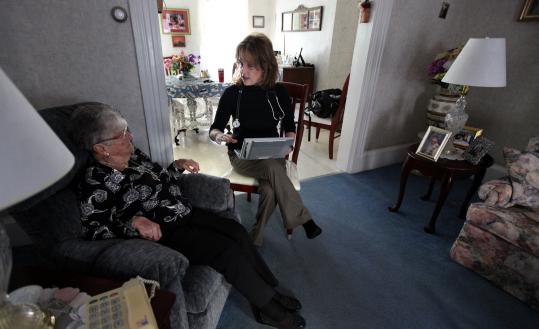
DeAnne Nignault of the Visiting Nurse Association of Boston, conducts a follow-up visit with patient Ann Boyle (Photo courtesy of Boston Globe/Pat Greenhouse)

Return to www.thinkhomecare.org.

Boston Globe: MA Lags on Assisted Living Homes

The Boston Globe reported on a Harvard Medical School study that revealed Massachusetts is below average when it comes to assisted living slots per resident over 65 years old.

The study’s lead author, and an assistant professor of health policy at Harvard, David Stevenson mentions the appeal of assisted living as well as home care:

“It comes down to what kind of long-term care we as a society think people should have access to,’’ Stevenson said. “Anyone who can avoid being in a nursing home does, whereas assisted living is hugely appealing to people, as are community-based and home services.’’

This quote, and the article in general, reiterates the importance of home care in that it is preferable to institutional care. Stories like this present the industry with an opportunity to remind policymakers that home care reaches the entire state without regard to income or location.

Return to www.thinkhomecare.org.

ThinkHomeCare.org Promoted on WBZ Radio

The Home Care Alliance is promoting the website “thinkhomecare.org” on WBZ News Radio (1030-AM) with an ad that is themed around keeping the entire family home for the holidays.

Return to www.thinkhomecare.org.

Senate Passes Health Reform

See the following reports, including a video from CNN, on the Senate passing health reform. The vote was 60-40 along party lines as the Democrats were able to secure their necessary majority.

The bill still includes tens of billions in cuts to Medicare home health payments, although re-basing is delayed until 2014 and Senator John Kerry’s amendment to reduce the cuts by nearly $5 billion was included.

The Boston Globe

Elated Senate Democrats won the first critical procedural vote required to advance major health care legislation just after 1 a.m. this morning, one of four votes required this week to pass the proposal by their self-imposed Christmas deadline.

New York Times

The Senate bill, once completed, must be reconciled with the bill adopted by the House last month, and there are substantial differences between the two. The House measure, for instance, includes a government-run health insurance plan, or public option, that was dropped from the Senate bill.

UPDATE: Senate officially passes reform on Christmas Eve. See this story for more details.

Return to www.thinkhomecare.org.

Alliance to Lead State in National Quality Campaign

With federal and local health reform efforts focused on improving quality and cutting costs, The Home Care Alliance of Massachusetts will be the state leader in a new national campaign to reduce avoidable hospitalizations and improve management of oral medications though home health care.

Performed in partnership with the Centers for Medicare & Medicaid Services (CMS), a new and improved Home Health Quality Improvement (HHQI) National Campaign will launch January 13, 2010. As a HHQI Local Area Network of Excellence (LANE), the Home Care Alliance of Massachusetts is the central hub of campaign activity in the state.

See the Alliance press release on the HHQI campaign.

In 2007 and 2008, more than 5,500 home health agencies enrolled in the first HHQI National Campaign. Together they learned, shared best practices, and improved the care provided to their patients.

Return to www.thinkhomecare.org.

Boston Globe: South Boston Adult Care Program to Close

Due to the amendment in Medicaid Adult Day Health regulations meant to save $6 million, many adult day health centers will be closing their doors. Among them is Catholic Cahrities’ Laboure Center, which serves 45 elders and adults with special needs.

The Boston Globe reported on the closing of the Laboure Center that will shut down on December 31.

The budget cuts will impact centers across the state, as the following excerpt explains:

Because of the new state regulations, which went into effect Nov. 15 as part of an effort to cut $6 million in Medicaid spending, at least 50 percent of adult day program participants are ineligible for some basic care, according to the Massachusetts Adult Day Services Association.

Call the Governor’s office TODAY at 617-725-4005 and urge him to take action!

Return to www.thinkhomecare.org.

New Home Oxygen Safety Info Available

The Massachusetts Department of Fire Services (DFS) recently released a new guide for Home Oxygen Safety. The flier has useful tips and phone numbers for patients, families, doctors, nurses and first responders.

For more information, visit the DFS website at www.mass.gov/dfs.

Return to www.thinkhomecare.org.

Boston Globe: Senate Dems Negotiate Public Option

The Boston Globe has reported that liberal and moderate Democrats in the Senate have reached a tentative deal “to drop a full-fledged government-run insurance plan from the health care overhaul bill and replace it with a patchwork of new ideas to help people get coverage, according to a Democratic Senate staffer.”

Senate majority leader Harry Reid announced that a team of 10 liberal and moderate Democrats had reached “broad agreement’’ on a compromise that would allow Senate Democrats to move the bill forward.

Reid did not provide details, saying he wants congressional budget analysts to determine its cost. But he implied it could garner the 60 votes required to clear the way for passage.

“The question is . . . is the end in sight?’’ Reid said, responding to a reporter at a brief press conference. “The answer is yes.’’

The article highlights some possible new provisions to provide health coverage to the uninsured and explains other recent action taken on the health reform bill. Since the House passed the government-run insurance option to compete with private insurers, that difference, among others, will have to be reconciled by House and Senate negotiators.

Return to www.thinkhomecare.org.