Home Health, EHRs and Data Interoperability

In 2011, the Centers for Medicare and Medicaid Services launched the “Meaningful Use (MU) initiative to incentivize certain sectors in the US health care system to move toward electronic health records (EHR) that would be used in a meaningful manner that allows for the electronic exchange of information to improve continuity and quality of care. Significant financial incentives were provided to “eligible providers” – essentially defined as hospitals and physician practices. More than $20 billion was spent and more that 600,000 eligible providers were enrolled. Home health, behavioral health and skilled nursing facilities were not eligible.

Now, it seems there is some limited acknowledgement that it may be time to rethink that. In a proposed rule relative to interoperability just published in the Federal Register, CMS is including – as a Request for Information – an ask for any feedback as to how to improve data interoperability for providers that have as yet received any incentives for using electronic health records.

“Transitions across care settings have been characterized as common, complicated, costly, and potentially hazardous for individuals with complex health needs. Yet despite the need for functionality to support better care coordination, discharge planning, and timely transfer of essential health information, interoperability by certain health care providers such as long term and PAC, behavioral health, and home and community-based services continues to lag behind acute care providers,” the proposed rule says.

CMS acknowledges that a contributing factor to the lag in Interoperability among post-acute care providers was that they were not eligible for incentives under the program formally known as meaningful use. CMS asks for input on specific ways it could financially help these sectors adopt and use technology.

CMS also asks for feedback on measurement concepts and quality improvement steps that could feasibly be applied to post-acute care, behavioral health and home and community based-services providers. Given that mandate in the IMPACT ACT that certain patient assessment data should be standardized and CMS is interested in feedback as to what parts of that data set — or the whole IMPACT Act data set — would be appropriate to include.

Adding some fuel to what may be an obvious fire (no incentive = limited movement) is a just published study in the Journal of the American Medical Directors Association that examined gaps in communication between hospital and home health care staff, concluding that some could have serious medical consequences.

The authors surveyed nurses and staff at 56 home health agencies throughout Colorado. Participants were sent a 48-question survey covering communication between hospitals and agencies, patient safety, pending tests, medication schedules, clinician contact and other areas. Although almost all (96 percent) respondents indicated that Internet-based access to a patient’s hospital record would be at least somewhat useful, fewer than half reported having access to EHRs for referring hospitals or clinics. No surprise: getting medication doses right due to conflicting information was identified as a major problem.

Their conclusion: Future interventions to improve communication between the hospital and HHC should aim to improve preparation of patients and caregivers to ensure they know what to expect from HHC and to provide access to EHR information for HHC agencies.

Comments to CMS will be due in April. Date not yet announced.

Return to www.thinkhomecare.org.

PDGM Fix Introduced, Advocacy Needed

Last week, a bipartisan group of senators, led by Sen Susan Collins (R-ME)  introduced what will be a most important legislative priority for HCA of MA this year.  Senate bill (S.433) will curtail the so-called $1 billion “behavioral adjustment” cut under the Patient Driven Groupings Model (PDGM) to which all of home health is transitioning in 2020.  Among, many other changes, PDGM will move home health from a 60 to a 30 day payment unit. This is the most significant change to home health payment since the Prospective Payment System was introduced in 2000.

The Congressional action that called for a home health payment overhaul required that the new payment model be budget neutral against current spending levels. However,  the legislation also allowed that CMS to consider “behavioral  adjustments” defined as industry actions that would be taken to increase payment under the new model, unrelated to patient case mix changes. CMS has used this authority very broadly to institute a payment adjustment in the first year of PDGM based on “assumptions” of behavioral changes, and that adjustment calls for a 6.42% base rate reduction, or a possible $1b reduction in payments.

S 433 would prohibit CMS from making any pre-rate change reductions based on assumptions and instead to phase in any adjustments (either up or down) based on observed evidence (i.e., data supported) changes in provider behavior. The objective would be to achieve budget neutrality by 2029. This later piece addresses concerns the Congressional Budget Office (CBO) expressed regarding whether a similar bill introduced last session was truly budget neutral. S.433 also would allow Medicare advantage plans and Center for Medicare and Medicaid Innovations (CMMI) to waive the “confined to home”  provision when in the best interest of a Medicare beneficiary.

Regardless of the “behavioral adjustments,” the PDGM model is expected to have a tremendously varied impact state by state and agency by agency.  A significant amount of this impact is related to a Congressional  requirement that the payment model no longer use the volume of therapy as a payment level determinant.  (Something MEDPAC has been calling on CMS to do for years.)   The state of Florida, where therapy visits average 10.45 per episode of care is set to “lose” the most – projected at $141 million.  California on the other hand, where the average therapy utilization per episode was 5.76,  will be the largest gainer.  MA (need numbers from Tim)  Note: S 433 does not seek to make changes to the structure of the payment model that produces these changes.

It is important to reflect on CMS’ proposal in 2017, Home Health Groupings Model (HHGM) and how we arrived to where we are today. At the time, HHGM represented similar changes to the payment model, without soliciting industry feedback and some estimates predicting a 15% reduction in payments. As a result, the industry unified itself behind one message: that CMS withdraw its proposal and engage stakeholders to come up with an alternative. Upwards of 13,000 emails were sent to Congress from the industry, 49 members of the U.S. Senate and almost 160 members of the U.S. House of Representatives signed onto letters to CMS echoing the request to withdraw HHGM. This was a remarkable show of mobilization by the industry and we’ll need it again to make modifications to PDGM.

At present there is no bill in the House, but it is expected that one will be forthcoming.  Strong early sign on support is critical to keeping this bill moving and HCA of MA will be urging members to contact the MA delegation to support S.433 and the companion house legislation to be introduced. Stay tuned for these advocacy alerts in our weekly newsletter and advocacy messages in the coming weeks.

HCA will also be hosting a number of member events to prepare for the payment transition.  While the full day PDGM programs in March in Northampton are sold out, there will be a high concentration of sessions on PDGM at the New England Home Care Conference and Trade Show in on June 5 -7 inn Falmouth. Watch here for more details.

In the meantime, send a message here to Senators Warren and Markey about the need for their support on this issue. 

Let’s do this home care – we cannot sustain $1 billion in cuts based on assumptions, not facts!

The “Agency Advantage,” Explained

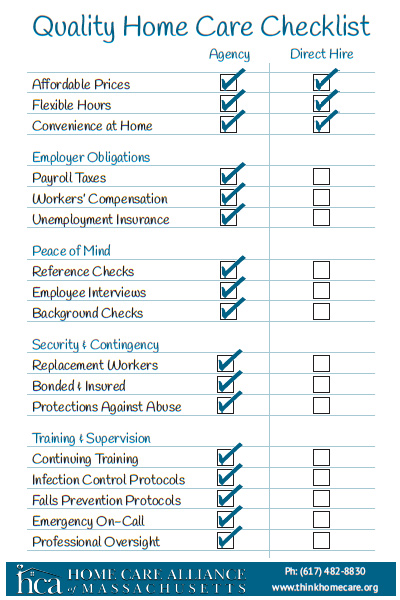
Many families ask why they should work with a home care agency rather than hiring a nurse or aide themselves. Re-designed to better answer that question, The Agency Advantage is a one-page flier that describes the benefits of contracting with an agency compared to a direct hire. Best of all, blocks of up to 50 are available at no charge to members.

In addition to describing the benefits of working with an agency, it also shows the advantages as a checklist:

Return to www.thinkhomecare.org.

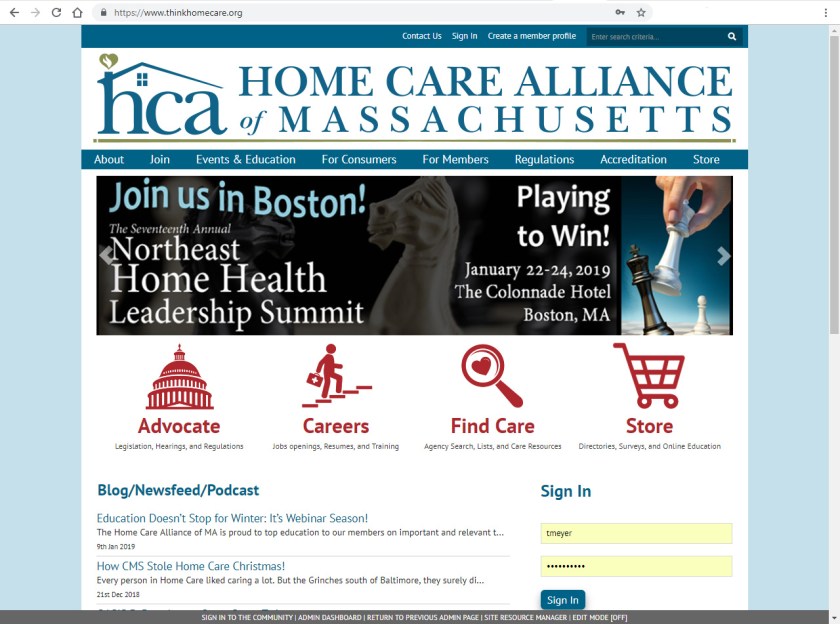
The New ThinkHomeCare.org

The Alliance is extremely pleased to announce the first re-launch of its website in nearly five years.

Screenshot of the new design.

Design & Home Page Changes

  • A clean, responsive design that works both for desktop and mobile platforms;
  • Member sign-on available directly on the home page and many sub-pages; and
  • New red button highlights and a simplified navigation menu to direct members & non-members alike to topics of interest.

Function & Enhancements

  • A new Education Page with categories that that filter for the events you’re looking for;
  • An overhauled Association Store with better categories and clearer organization;
  • A brand-new Library of Recorded Webinars, some available for purchase (at reduced rates for members), some available at no charge;
  • A redesigned Find-an-Agency search helps families find services that meets their needs; and
  • A new, members-only page listing money-saving Group Purchase Programs available through the Alliance.

As with all websites, we’ll continue to make changes and enhancements over the coming weeks and months. If you have any problems or suggestions, please contact me at tmeyer@thinkhomecare.org.

Return to www.thinkhomecare.org.

Education Doesn’t Stop for Winter: It’s Webinar Season!

The Home Care Alliance of MA is proud to top education to our members on important and relevant topics. There are roughly 5-8 programs held a month and during the winter, they mostly belong to webinar education! Webinars are a cost effective way of educating your staff – you pay an affordable price for one line and have staff gather in a room to listen together, or access the recording for a later date training.

Below you will find some of our current webinars being offered which range in topics from Coding to CASPER reports to Aide education.

There are continuously new programs offered including on-site education, trainings, and conferences. Check out our calendar on our website to stay the most informed!

Contact Megan Fournier at mfournier@thinkhomecare.org or 617-482-8830 for any questions!

How CMS Stole Home Care Christmas!

Every person in Home Care liked caring a lot.

But the Grinches south of Baltimore, they surely did not!
The Grinches hated home care, delivered in any which way.
Now, please don’t ask why. No one knows what to say.

It could be CMS didn’t have a mom or a dad.
It could be their jobs were incredibly sad.
But, the most likely reason was this just this my dear,
Their hearts were hijacked by nasty old fear.

They feared the support, the need and the caring.
“It has to stop now,” they said, nostrils flaring!
“I hate all their teamwork! I despise all they do!
I’ll pick them all off, one-by-one, two-by-two!”

With a laugh and snort, they sneered, “I know just what to do!”
And put pen to paper to plot their evil, awful coup.
They threw it all at us, with the usual glee,
COPs, OASIS changes, and even VBP!
“I’ve ruined them now and forever, I swear,
Let’s see how you cope, how you can possibly still care!”

But across the Land of Home Care, they got down to work.
HCA had their back, a membership perk!
Every worker in home care, the small and the tall,
Still kept making visits, swearing once and for all:
“The families, they need us, and we will be there!
No Grinches in DC can stop us with fear.”

And what happened then? Well… in home they say,
Those Grinches’ hearts grew three sizes that day!
The true meaning of home care shined right on through.
They ripped up their papers, stopped pre-claim review.
“Maybe home care,” they said, “isn’t about regs, or rules.
Maybe home care is bigger, a national jewel!”

“Thank you, home care,” they said, now with a smile.
“For once, in your shoes, maybe I’ll walk a mile.
I’ll make a home visit, I’ll assist with a med.
I’ll listen to stories from clients in bed.”

“I’ve a new understanding why you do what you do.
Let’s make a new year that’s bright with a start that’s brand new!”

Return to www.thinkhomecare.org.

OASIS D-Day: Assess Once, Score Twice

In less than three weeks, home health agencies will be transitioning from OASIS-C-2 to the new OASIS D assessment. Given all the regulatory changes this year and with the holiday season upon us, it has really been a sprint to get staff trained.

HCA of MA recently held three training sessions for members and not surprisingly there is concern with staff being ready, especially around the nuanced degrees of functional assessments and specifically related to the new items related to mobility and self-care.  While OASIS-D comes advertised as “dropping 28 previous M-Items” from OASIS-C-2, the additional assessments will require lots of creative patient engagement on the part of the admitting nurse or therapist, according to HCA Director of Regulatory and Clinical Affairs Colleen Bayard.

“OASIS-D is intended to begin to standardize patient assessment and quality measures across all post-acute providers,” said Bayard. “But for us in home care some of the new items ask for very nuanced responses. For example, the mobility item (GG0170) has 17 mobility activities that  the clinician must  ‘code’ with a  6-point scale from independent to dependent or  ‘code’ with 4 possible responses related to ‘activity not attempted.’ he admitting clinician is responsible for assessing a patient’s ability to stair climb, pick up an object from the floor and even make a car transfer.

During the Alliance’s trainings, Bayard warned agencies to expect some productivity issues related to the learning curve,  but stressed that the training message across the industry should be: “assess once, score twice.” In other words, be aware of OASIS M assessment questions which track to newly added  GG assessments and use the same assessment to respond to multiple OASIS items in the same category.  Bayard also recommends close auditing or self-monitoring in the initial months, especially related to the responses “patient refused” or “dash” (not attempted). (Ask:  could the clinician interview a family member as a way to get a response?)

Bayard recommends using the “Expansion of the one Clinician Rule” to your advantage because CMS is encouraging an interdisciplinary team approach with OASIS-D. Bayard’s final advice: “As you focus on your training be aware that your nurses are going to need to have a strong intersection of observational skills with interview skills.”

HCA has several places members can come to share and learn as they move past Jan 1. Our Clinical Directors and Quality Improvement list serves and networking groups will be highly focused on OASIS-D as winter turns to spring.  The Clinical Directors next meet Thursday, January 10 and the QI Managers will next meet on January 9th. Meeting information is here. Our email groups are here.

If you haven’t already studied it – here is a list of more than 100 answers to OASIS questions received by CMS from the industry during recent CMS in-person trainings and webinars.

Return to www.thinkhomecare.org.

Talking Home Care: NAHC’s Calvin McDaniel on the 2018 Midterm Elections

Calvin McDaniel of NAHC joins us to talk about the implications of the 2018 Midterm Election on the home care industry.

Kelleher and McDaniel

On this week’s edition of Talking Home Care, we are joined by Calvin McDaniel, Director of Government Affairs for the National Association for Home Care & Hospice (NAHC). Calvin oversees NAHC’s legislative priorities on Capitol Hill, and collaborates with the Alliance and other state associations on shared, industry-wide priorities.

Our discussion recaps the 2018 Midterm Elections and what to expect in the 116th Congress, which will be seated in January 2019. Enjoy!


You may listen to the podcast by clicking the play button below, downloading it directly, or subscribing through iTunes or Google Play. (Length: 29 minutes; Size: 23.2 MB). If you enjoy it, please give us a five-star review so others can find it.

Host: Patricia Kelleher is the Executive Director of the Home Care Alliance of Massachusetts.

GuestCalvin McDaniel, Director of Government Affairs for the National Association for Home Care & Hospice (NAHC).

2018 Midterm Elections Recap (Updated Monday, 11/19):

  • Democrats regained control of the US House of Representatives, gaining 37 seats so far and holding a majority of 233 seats to Republicans’ 198 seats.
  • Republicans held control of the US Senate picking up two seat as and expanding their Senate Majority to 52 seats to Democrats’ 47 seats. The Mississippi senate seat is heading toward a run-off election on November 27th.
  • On the state level: Democrats flipped nearly 400 state legislative seats nationwide, flipped seven Republican-held governor seats, and took full control of the legislature and Governors’ mansion in seven states.
  • Lastly, three states: Idaho, Nebraska and Utah voted to expand Medicaid. And a fourth state, Maine, elected a democratic governor, who will likely do the same.
  • Overall, nearly 116 million voters cast ballots, representing over 40% of eligible voters and represents the largest midterm voter turnout in 104 years.
  • It is expected that Representative Richard Neal (D-MA) will become the Chairman of House Ways & Means, and Representative Jim McGovern (D-MA) will become the new Chairman of the Rules Committee. This greatly increases the Massachusetts’ Congressional Delegation influence on Capitol Hill.

The most important takeaway from our conversation with Calvin is that HCA members should prepare for an incredibly active two years of advocacy. Take hold of your responsibility to engage your elected officials on behalf of your organization and join us in the fight on the many issues facing our industry. Be it an email to a legislator, inviting them to your offices for a tour or on a home visit, or taking time to join us in D.C. for one of the many fly-in events, it takes an army of voices to accomplish a common goal. To get involved, email Jake Krilovich.

Return to www.thinkhomecare.org.

Home Care Month 2018: Building a Workforce for the Future

Today marks the start of Home Care Month. This is the first of several blogs post reflecting on the current issues impacting the industry.

Every day in this country, 10,000 baby boomers turns 65. This new generation of “elders” are unlike any other to come before it. Economists suggest that these baby boomers control 70% of all US disposable income, yet a large percentage are not well prepared financially for retirement, with savings far below what they are projected to need to “sustain their quality of life.” Thanks to medical advances, these aging boomers should have a longer life expectancy than even the generation before them. They are more educated. They are accustomed to speaking up about their health care needs and they are technologically savvy. And without a doubt, they will be looking for a long-term care delivery system that meets their needs, allows them to age in place with some degree of financial security and with little dependence on their children (whom many boomers are still supporting!).

In short, they will want a high-quality, cost-effective, technologically-advanced home care delivery system. As we celebrate home health care month in Massachusetts and around the country, let’s look at some of what we need to do to make sure we have that in place.

Starting with Workforce Issues

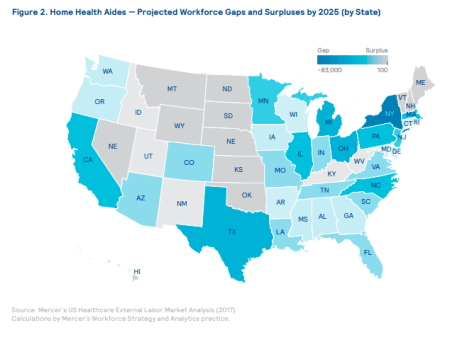
This chart from a recent report from global health care consulting firm, Mercer, depicts what many have written about: There is a huge gap between the availability of a home health aide/personal care workforce and patient need. Massachusetts is among the states expected to feel it the most, and the graphic speaks to how much has to be done in this area.

Home health agencies – dependent on heavily regulated Medicare and Medicaid funding for most of their services – are increasingly unable to offer wage and benefit packages that allow them to compete within the health-care or service-delivery sectors. Added business costs such as the state’s EMAC assessment and mandated paid sick leave make it harder for private home care companies to keep costs affordable and attract workers. Already, many report more demand than they have the workforce to meet.

To ensure an available, productive, and healthy workforce we support:

  • Repealing the onerous EMAC assessment on agencies whose workers access public insurance (Medicaid);
  • Providing premium assistance or pooled purchasing of health insurance for direct care workers;
  • Adequately adjusting Medicaid reimbursements to cover living wages and benefits; and
  • Investing now in the creation of a meaningful, long-term care workforce training, with nurse and aide training funds.

Looking at Technology

There are many who think some of the workforce demand can be offset with the new technologies emerging to support aging at home. These include sensor devices that can detect a multiplicity of conditions and situations including missed meals or medications, a problematic change in weight or blood pressure, or a fall. According to a recent report by the MA state Auditor’s office:

The potential for technological change to impact the labor requirements for home health/direct care workers is considerable. As low cost technologically-based products become available it is likely that these emerging products and services will serve as both substitutes for and complements to home health/direct care occupations.

Most of these technological devices require a receiver to get and act on the collected data. While in some cases this may be a family member, it should also be noted that home care agencies are appropriately poised to be the monitor of remotely transmitted systems, sending a nurse or aide to visit only as indicated. As workforce issues intensify, we would like to see and support:

  • More insurance coverage, including Medicare and Medicaid for remote monitoring devices
  • More modeling of partnerships between private home care companies and technology vendors to test the market for, and price, care extender technologies as part of a private home care plan of care.

Home Care Month is a time to honor the contributions of home health workers who are the lifeline to health care for some many home-bound elders, for isolated and struggling families and for the disabled. Let’s also use this opportunity to listen to and respond to their needs.

Return to www.thinkhomecare.org.

Talking Home Care: Amanda Oberlies on “No on MA Ballot Question 1”

Amanda Oberlies of the Organization of Nurse Leaders joins us to discuss why her organization (and the Alliance) oppose Massachusetts Ballot Question #1.

The Alliance’s Pat Kelleher &
ONL’s Amanda Oberlies

Should health care facilities have their nurse-to-patient ratios defined by law? That’s the question put to Massachusetts voters this coming Tuesday. Amanda Oberlies of the Organization of Nurse Leaders joins us to discuss why her organization (and the Alliance) oppose Massachusetts Ballot Question #1. Their conversation covers:

  • Who’s behind the ballot question and why?
  • What is the intersection of staffing-ratios and quality?
  • How does California’s experience with a similar law correlate to the MA proposal?


You may listen to the podcast by clicking the play button below, downloading it directly, or subscribing through iTunes or Google Play. (Length: 30 minutes; Size: 24 MB). If you enjoy it, please give us a five-star review so others can find it.

Host: Patricia Kelleher is the Executive Director of the Home Care Alliance of Massachusetts.

Guest: Amanda Stefancyk Oberlies, PhD, MBA, RN, CENP, is the Chief Executive Officer of the Organization of Nurse Leaders (ONL).

Resources:


Talking Home Care LogoDon’t want to miss the next episode of Talking Home Care? Subscribe through iTunes, Google Play, or accessing its feed directly.

Return to www.thinkhomecare.org.