
Metrowest Home Care & Hospice Honored for Their Work

Congratulations go out to MetroWest Medical Center which, in collaboration with MetroWest HomeCare & Hospice, has been awarded the 2010 Betsy Lehman Patient Safety Recognition Award. The award honors leadership and innovation in patient safety and the development of systems-based solutions through the implementation of best practices. The theme for this year’s award focused on the importance of transitions in care across the healthcare continuum.  Jane PikeBenton, Executive Director at MetroWest HomeCare & Hospice, presented their innovative approach at the most recent statewide STAAR Learning Session and sent this along to the Home Care Alliance:

“ At Metro-West, we implemented a multi-faceted approach to the transitioning of patients that was designed and implemented via a strong cross-continuum collaboration between the home health agency and the hospital. The model includes:

  • the implementation of a ‘teach back tool’ for patients with heart failure both within the hospital and through their transition to home with home care services
  • the development of a standardized Heart Failure Protocol with front loading of home care visits, the use of a standardized teaching tool based upon evidenced-based research, an increase focus on medications, and the integration of phone calls by the home care case managers on non visit days
  • post hospital telephonic support via the use of a calling center in conjunction with the MetroWest HomeCare Nurse Specialist intervening for these patients when gaps in care are identified
  • the implementation of a Transition Care Coach who is also a MetroWest HomeCare Nurse who meets with the patients bedside prior to discharge from the hospital
  • the implementation of a Palliative Care Team with members from both MetroWest Hospice and MetroWest Medical Center

These initiatives demonstrate the importance of cross-continuum collaboration to our patients and to our health care system. Our entire team is committed to implementing new and innovative ways to provide care for our highest risk patients, and to demonstrate the value that home health care offers to hospitals and other health care partners.”

Among those sending congratulations to MetroWest HomeCare & Hospice and MetroWest Medical Center on their innovative approach to patient care across the continuum was HHS Secretary Judy Ann Bigby, MD.  Her comments as to MetroWest as a “shining example” were posted on the Commonwealth Conversations Public Health Blog.

Thank you to Jane and her team for demonstrating leadership in this crucial area of care transitions and readmission reduction.

Physician Face to Face Encounter Update

The Home Care Alliance wrote an article in the Massachusetts Medical Society’s newsletter in an effort to further educate physicians on the CMS face-to-face encounter requirement. The article was written at the beginning of the year and published in the February edition of “Vital Signs,” the MMS newsletter, although much has happened since then.

With one month left until the April 1st enforcement deadline, the Alliance continues to provide updates as they become available. To that end, some new important Q&A’s have been posted on the CMS website, which are available here.

A few of the new Q&A’s are listed below:

Return to www.thinkhomecare.org.

Study Looks at Home Care to Nursing Home in Mass

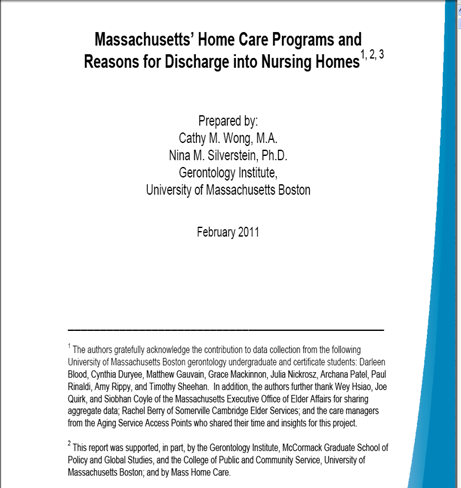
The Gerontology Institute at the University of Massachusetts/Boston this month released a study on Massachusetts’ Home Care Programs and Reasons for Discharge into Nursing Homes. The study, which was partially funded by Mass Home Care, looked at a program snap shot for March 2010, at which time there were 32,417 clients enrolled in the Home Care Basic program, 5,221 clients in Choices, and 4,563 clients in ECOP.

The study concluded that 13% of Home Care Basic clients, 17% of Choices clients, and 20.6% of ECOP clients were terminated from the home care programs and placed into a nursing home.  Further examination of a subset of clients and interviews with case managers indicated – as home care agencies well know – more and in many cases a more skilled level of community based services is needed to keep clients from nursing homes.   Not surprisingly the interviewed care managers call for more 24/7 care options, but the study also calls for  more help for patients with medication administration, falls risk assessment and home safety assessment and improved coordination with medical providers, especially in the area of pain management.

While there has always been a push in the state home care program against “over-medicalization” of the benefits purchased, it seems clear from this report that there may need to be movement towards supplementing homemaker and home health aide with more professional support for certain clients.

ASAP providers: Does your experience match up with this report?   Do you have comments that you would like to see reflected in feedback from the Alliance to EOEA?

Return to www.thinkhomecare.org.

Reminder: CMS Forum on Value-Based Purchasing

This is a reminder that the Centers for Medicare and Medicaid Services (CMS) will be hosting an “Open Door Forum“on designing a value-based purchasing program for home health agencies. The forum is intended to solicit input from all parties interested in implementing such a program.

CMS Special Open Door Forum

Designing A Home Health Value Based Purchasing Program

Thursday, February 24th from 1:30-3:00pm (Conference call only)

Value-based purchasing (VBP) is meant to link payment more directly to the quality of care provided and is along the same lines of other payment reform efforts seeking to reward providers for delivering high quality and efficient clinical care.

Section 3006 of the Affordable Care Act requires the Secretary of Health and Human Services to develop a plan to implement a value-based purchasing program for payments to home health agencies under the Medicare program.

CMS will be seeking stakeholder input on a number of topics defined in the statute including:

  • The ongoing development, selection, and modification process for measures of quality and efficiency;
  • The reporting, collection, and validation of quality data;
  • The structure of value-based payment adjustments, including the determination of thresholds or improvements in quality, the size of such payments, and the sources of funding for the value-based bonus payments;
  • Methods for the public disclosure of information on the performance of home health agencies;
  • and any other issues.

If you wish to participate on Feb 24th, dial 1-800-837-1935 – Conference ID 37941789.

More information on this and other CMS Open Door Forums is available here.

Return to www.thinkhomecare.org.

Regulatory Review

Expedited Review Process:

Masspro completed a series of workshops to discuss the “expedited review process,” used by home health agencies to notify Medicare beneficiaries that their Medicare services are ending. There are two separate forms and slightly different rules depending on Medicare “fee-for-service” (Notice of Medicare provider Non-Coverage) or Medicare Advantage (Notice of Medicare non-Coverage).  These forms are to be used when all Medicare services are ending for medical reasons.  If care is ending for a technical reason such as homebound, then the beneficiary is given a HHABN.  This is a recent clarification from Quest to Masspro our local QIO.

Quest is the part of the Quality Net system that QIO’s use to communicate with CMS.  QIO’s can ask Quest questions that require clarification by CMS and then publish the answers.

Is it appropriate for the HHA to issue a Notice of Medicare Provider Non-Coverage in these types of cases, and for the QIO to review?

Answer:

It is not appropriate for HHAs to issue Notices of non-coverage for home-bound status; only when it is believed that the beneficiary no longer requires a skilled level of care

Face-to-Face:

CMS put out a transmittal a few weeks ago to define several dates that relate to the Face-to-face Requirement.

The effective date is January 1, 2011

The implementation date that CMS contractors must have their systems ready is March 10, 2011

The enforcement date is April 1, 2011. After this date, agencies will not be reimbursed if the F2F documentation is not present in the medical record.

Return to www.thinkhomecare.org.

Spread the Word with Our New Home Care Posters

The Alliance’s 2011 Home Care Posters are now available for order.  Handsome and professionally-printed, they’re perfect for display in councils on aging, senior centers, hospitals, doctors offices, Churches, or anywhere people in need of home care might see them!

The posters direct viewers to our website, www.thinkhomecare.org, where they can use our online Find An Agency or our Print Directories to find an agency that suits their needs.

Tens of thousands of people in Massachusetts live independently at home with the help of home care. If your family needs help, our online directory can match you with the agency that best suits your need, whether it’s for care 24 hours a day, or just a few hours a week.

Details:

  • Shipped in packages of two, with one poster of each design;
  • Posters are full-color and printed on 100-lb, 11 x 17″ cardstock;
  • Shipped flat and with an extra cardboard insert so posters are protected and ready to mount the moment they arrive;
  • All packages include four self-adhesive, wall-friendly strips for easy mounting and removal.
2011 Poster - Blue

Return to www.thinkhomecare.org.

Join HCA for Home Health Care Advocacy Day

With the legislature looking hard at cost-saving measures and the Governor’s payment reform bill moving to the legislature for analysis, now is the time to get involved in the Home Care Alliance’s advocacy efforts.

This is also why this year’s Home Health Care Advocacy Day is so important.

Taking place from 10:00 am to 11:30 am on March 3 in Room 437 of the Massachusetts State House, this event will feature expert speakers touting the value of home care to legislative staff and HCA members who are ALL encouraged to attend.

Materials will be available for HCA members who wish to stop by legislative offices and relay what they heard at the briefing after the event concludes.

Registration is not required, but please contact the Alliance if you or someone from your agency plans on joining us for this important day so that we know how much materials are needed.

Return to www.thinkhomecare.org.


Governor Releases Health Reform Legislation

Today , Governor Patrick released proposed legislation “Improving the Quality of Health Care and Controlling Costs by Reforming Health Systems and Payments.” The bill calls for  “Encouraging the formation of integrated care organizations, commonly referred to as accountable care organizations, comprised of connected or integrated groups of health care providers that achieve improved health outcomes and lower the costs of care.

The bill does not explicitly define provides and services that must be encompassed in an ACO instead defining an ACO as “an entity comprised of provider groups which operates as a single integrated organization that accepts at least shared responsibility for the cost and primary responsibility for the quality of care delivered to a specific population of patients cared for by the groups’ clinicians; which operates consistent with principles of a patient centered medical home and satisfies the other requirements of this chapter; which has a formal legal structure to receive and distribute savings;  The bill does anticipate that “certain providers that are not primary care providers may be ACO network providers in more than one ACO, as set forth in regulation by the division.”    The “division” which has authority to draft authorizing regulations is the Division of Health Care Finance & Policy.

The bill calls for greater transparency in payment arrangements and requires that by March 31, 2012, the “Division will “document, categorize and publish all current payment arrangements in the commonwealth between payers and providers.”   Medicaid participation in the ACO model is envisioned by 2014.

The Alliance will be reviewing this legislation with the Legislative and Policy Committee and the Board of Directors and welcomes member feedback. as to whether home health’s role should be more explicit in this legislation.

Return to www.thinkhomecare.org.

2011 Resource Directories Arrive!

2011 Resource DirectoryMore than 2,200 2011 Home Health Resource Directories arrived at the Alliance’s office today.  We’ll being mailing out copies over the next few weeks.

The 2011 edition  combines thoroughness with ease-of-use to give you the best guide to home care services in Massachusetts.  If you’re a nurse, social worker, GCM, or anyone else who needs to find the best home care agency to fit your patient’s needs, this is the one resource you need.

The Resource Directory lists our 189 agencies alphabetically — 15 more than last year — complete with full contact information and a description of the services they offer.  It also contains a detailed town-by-town cross reference that lets you find local agencies can provide service to your patient.  Sample pages are available here.

New to the 2011 Edition, the Resource Directory explicitly lists which agencies are Medicare Certified and which have received the Alliance’s Agency Accreditation.

You may order copies on our website or by using the form below, or can download an order form to fax back to our office.

Return to www.thinkhomecare.org.

More Face To Face Clarifications Issued

The following was issued by NAHC Regulatory Affairs

CMS issued an update to the Medicare Benefit Policy Manual, Pub 100-02 Chapter 7 via a Transmittal issued this afternoon at: http://www.cms.gov/transmittals/downloads/R139BP.pdf. Summarized below are new pieces of information (including exception in case of death of patient) and clarifications found in the Transmittal.

General Issues

  • The certifying physician must document that he or she or an allowed non-physician practitioner (NPP) had a face-to-face encounter with the patient.
  • Certain NPPs may perform the face-to-face encounter and inform the certifying physician regarding the clinical findings exhibited by the patient during the encounter. However, the certifying physician must document the encounter and sign the certification.
  • The documentation must include the date when the physician or allowed NPP saw the patient, and a brief narrative composed by the certifying physician who describes how the patient’s clinical condition as seen during that encounter supports the patient’s homebound status and need for skilled services on the certification or an addendum to the certification.
  • It is acceptable for the certifying physician to dictate the documentation content to one of the physician’s support personnel to type.
  • It is also acceptable for the documentation to be generated from a physician’s electronic health record.
  • It is unacceptable for the physician to verbally communicate the encounter to the HHA, where the HHA would then document the encounter as part of the certification for the physician to sign.

Exceptional Circumstances in Case of Death:

  • · When a home health patient dies shortly after admission, before the face-to-face encounter occurs, if the contractor determines a good faith effort existed on the part of the HHA to facilitate/coordinate the encounter and if all other certification requirements are met, the certification is deemed to be complete.

Hospitalist Role

  • A physician who attended to the patient in an acute or post-acute setting, but does not follow the patient in the community (such as a hospitalist) may certify the need for home health care based on his/her contact with the patient, and establish and sign the plan of care. The acute/post-acute physician would then transfer/hand off the patient’s care to a designated community-based physician who assumes care for the patient.
  • Or, A physician who attended to the patient in an acute or post-acute setting may certify the need for home health care based on his/her contact with the patient, initiate the orders for home health services, and transfer the patient to a designated community-based physician to review and sign off on the plan of care.

Return to www.thinkhomecare.org.