
| On Wednesday January 3rd , the Massachusetts Legislature returned for the second year of its two-year session. After a seven-week recess, the body is looking at a traditionally busier second half than the first. The nearly 170 bills that passed in 2017 marked the lowest total in twenty years.
Lawmakers have until July 31 to complete all substantial legislative debate. In addition, all 200 members are up for election in 2018, which is expected to be a distraction from normal legislative work as a result of a polarized political landscape. Here’s what the Alliance will be focused on in 2018: Workforce Issues: Prior to the Holiday break, the Alliance met with its ‘Enough Pay to Stay’ partners to strategize coordinated efforts to attain wage relief for direct care workers and ASAP case managers. The coalition has pending legislation which would take steps toward this initiative, but we will pursue other legislative vehicles to fight for our workforce. Worker Registry: In November, Governor Baker signed into law the Home Care Worker Registry. This law will establish a worker registry that requires agencies contracting with ASAPs to submit workers’ private information to the state. The law is enacted and subject to regulations. The Alliance and its partners are in active communication regarding next steps toward protecting our members and their workers’ rights. Licensure: The FY 2018 State Budget included language that will establish a licensure process for home health agencies providing skilled services. It is unclear at this point when the process to promulgate regulations will begin, but the Alliance will be providing input to the Department of Public Health as these parameters are developed. In addition, Alliance-sponsored legislation that would license private care agencies is still making its way through the legislative process. Under procedural rules, the legislature has until February to report legislation out of committee. The Alliance will continue to advocate for passage of this legislation. Continuous Skilled Nursing: In late 2017, MassHealth announced two rate increases for the Continuous Skilled Nursing (CSN) program that totaled nearly 11 million. This was welcomed news, but there remains work to be done. The CSN provider/parent coalition will continue to advocate for the CSN Bill of Rights legislation that would mandate bi-annual reviews of the workforce to ensure safeguards against future crises. MassHealth Rates: The Alliance has been informed that MassHealth will conduct a long-overdue review of rates for per-visit nursing, therapies, and home health aide services. The Alliance will be working to gather data to demonstrate that the current low rates are interfering with agencies’ ability to attract and retain enough workers to meet the demand for services. MassHealth Reorganization: MassHealth’s initiative to enroll the majority of members into managed care programs this coming spring will dramatically change the way MassHealth members access home health services, and disrupt many existing provider referral relationships. The Alliance will continue to work to ensure that MassHealth members retain access to needed home health services, and that agencies are adequately reimbursed for those services. House of Representative Health Care Bill: Late last year the Senate passed a health care cost containment bill aimed at curbing costs while maintaining access. It has long been rumored that the House will be embarking on similar initiatives. Though the details are scarce, this legislation could be a vehicle for many of the Alliances priorities in 2018 and we will continue to advocate where necessary. If you have any questions about the year ahead for advocacy or would like to get involved, reach out to Jake Krilovich, the Alliance’s Director of Legislative and Public Affairs. |
Urge Gov. Baker to Veto Home Care Worker Registry!!
On Wednesday, the Massachusetts Senate passed H. 3821 in its current form which does not include ‘opt-out’ language for workers. The bill requires agencies contracting with ASAPs to report their name, gender, home address, mailing address, employer name, job title and training’s to the State.
Throughout this process, the Alliance and its coalition members have repeatedly raised concerns that disclosure of personal information such as home address and gender to third parties (defined as labor unions, home care agencies, and ASAPs) poses an enormous privacy violation.
In July, the Alliance asked members to request Governor Baker send this legislation back to the legislature with an opt-out provision. The Governor did just that, citing several of the same concerns that we have raised. Unfortunately, both chambers rejected the Governor’s amended language, and only added a victim of sexual assault, domestic violence and stalking amendment that requires workers to disclose these personal experiences to their prospective employer.
Governor Baker has 10 Days to act on H.3821 and we need members to email/call the Governor’s office today urging him to veto this legislation!! Use this alert to email the Governor’s office!!
We also encourage members to call the Governor’s office requesting him to veto H3821 and encouraging him to protect home care workers. To do so call: 617-725-4005
State Palliative Care Report Published, Work Group Seeks New Members
Last year, the state of Massachusetts’ Palliative Care Work Group commissioned the JSI Research & Training Institute to conduct a statewide and regional assessment on palliative care. In addition to reviewing the quality of palliative care in various settings, the report examined both accessibility and the factors that affect it. The work group, which is housed in MA Department of Public Health’s Comprehensive Cancer and Prevention Control Network, recently published the report. It examines availability of various models of care (e.g., hospital vs community-based), and the intersection of access and reimbursement, as well as public misconceptions and the need for more education. The report looks at access to care on a regional basis and includes an interactive map of identified palliative care services.
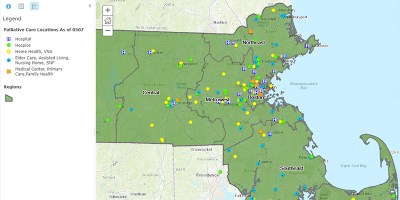
HCA of MA has also identified distinct palliative care programs on our consumer pages. Our online directory now includes a specific category for palliative care, and lists a total of eleven agencies that responded with information about palliative care to our recent survey.
As this work progresses, the state’s Palliative Care Work Group is looking for additional members to help provide consistent messaging about palliative care across the state. The next Work Group meeting will be Thursday, October 19, 2017, 11 AM – 1 PM at the American Cancer Society in Framingham.
Please email Colleen Bayard, cbayard@thinkhomecare.org if you would like to join the work group.
Return to www.thinkhomecare.org.
Talking Home Care Episode 4: NAHC’s Bill Dombi on HHGM and Federal Home Health Policy
Pat Kelleher talks with NAHC’s Bill Dombi about PDGM, reduced CMS spending, and more.

For the fourth episode of the Talking Home Care podcast, Pat Kelleher talks with Bill Dombi, interim president of the National Association for Home Care & Hospice (NAHC). Topics include:
- Background on the the Home Health Grouper Model (HHGM) and an update on its status;
- Discussion of the $950M/year reduction in overall home health spending, as estimated by CMS (and estimated to be much, much higher by NAHC);
- An update on NAHC’s lobbying efforts, specifically its support of a letter sponsored by Senators Nelson and Rubio to oppose the new model;
- How we need agencies to contact their representatives immediately (by the end of the Monday, September 25);
- How cuts may affect the home health workforce; and
- Holding the Trump Administration to its promise to reduce paperwork administrative overhead.
You may listen to the podcast by clicking the play button above, downloading it directly, or subscribing through iTunes or Google Play. (Length: 29’00”; Size: 14 MB).
Links/Action:
- Send a Message to Senators Markey and Warren urging the Senate to request CMS withdraw HHGM
- Send a message to Congress asking CMS to withdraw the proposed Home Health Grouper Model (HHGM)
- Background: “CMS Must Withdraw the Proposed Home Health Groupings Model“
 Host: Patricia Kelleher is the Executive Director of the Home Care Alliance of Massachusetts.
Guest: William Dombi was appointed as NAHC’s interim president this past August, and served as its vice president for law since 1987. He is also director of the Center for Health Care Law, a nonprofit, public interest law firm established by NAHC, and executive director of the Home Care and Hospice Financial Managers Association. Additionally, he is a member of the advisory board of Bloomberg BNA’s Medicare Report.
Don’t want to miss the next episode of Talking Home Care? Subscribe through iTunes, Google Play, or enter the following in your podcast app: https://thinkhomecare.wordpress.com/category/talking-home-care-podcast/feed/
Return to www.thinkhomecare.org.
Portraits of CareGiving – Enter Now!

To celebrate November as National Home Care Month, the Home Care Alliance wants to put your picture up in the MA Statehouse! So get out your iPhones and even — if you’d like — your selfie sticks, and send us a photograph of a day or a moment in your home care life! The photographs will hang the first week in November, and we hope they will tell in pictures a story of what you do every day across the entire Commonwealth to support those who are often invisible to elected officials and other parts of the health care system.
So get creative with it and let us show them what you do!
Find all of the details here.
Return to www.thinkhomecare.org.
Alliance Testifies on Home Care Legislation to Committee on Elder Affairs
The Massachusetts Legislature’s Joint Committee on Elder Affairs held a public hearing on July 31, 2017. Several of the bills heard are of interest to home care.
The committee heard testimony on bills relating to:
- Home Care Licensure/Worker Registries:
- S.364/H. 341 An Act Strengthening the Massachusetts Home Care Program
- H. 344 An Act Relative to Consumer Protection and Home Care Services
- H. 1187 An Act relative to home health and hospice aides
- H. 2068 An Act Establishing a Home Care Aide Training Registry
- H. 2889 An Act Strengthening Home Care Services
- S.343 An Act Establishing a Home Care Aide Training Registry
- Home Care Workforce Bill (Enough Pay to Stay Initiative)
- H.350/S.352 An act Relative to Home Care
The Home Care Alliance of Massachusetts and some of its members testified on all of the bills, and you can read that testimony at the links below:
- 7/31: HCA Testimony on Worker Registry Legislation
- 7/31: HCA Testimony on H.350 Section 1: Enough Pay to Stay
- 7/31: HCA Member Testimony on H.350 Section 1: Enough Pay to Stay
- 7/31: HCA Testimony on Licensure Legislation
- 7/31: HCA Member Testimony on Licensure Legislation Part 1
- 7/31: HCA Member Testimony on Licensure Legislation
If you have any questions, or would like any further information about these legislative proposals, do not hesitate to reach out to Jake Krilovich at jkrilovich@thinkhomecare.org.
Skilled Nursing Campaign Garners Media Attention
This week, the Alliance’s parent-provider skilled nursing campaign received national media coverage. The campaign seeks higher reimbursement rates from MassHealth for continuous skilled nursing services. Currently, agencies are unable to compete for nurses with area hospitals, and has led to a 37% nurse turnover rate, and nearly 24% of MassHealth-Authorized service hours going unfilled.
On Sunday, The Boston Globe featured a front-page story into the life of one of the parents caring for a child in the Massachusetts Continuous Skilled Nursing Program. Noelia Ferreira has gone over 100 days without a skilled nurse coming to her home to care for her daughter Abi. The article beautifully explains Noelia’s struggles to find adequate care and her commitment to keeping Abi safe at home.
As a result of this front page feature, WGBH invited Noelia and MA Pediatric Home Nursing Care Campaign founder, Angela Ortiz, to be interviewed by host, Jim Braude. Footage of the interview can be viewed here.
The campaign is leveraging this exposure to raise awareness and momentum in our fight for adequate reimbursement rates. Please visit www.mychildcantwait.com to write or call Governor Baker urging action.
Talking Home Care Episode 3: Andrea Cohen on Challenges and Successes for Private Home Care
Pat Kelleher and HouseWorks’s Andrea Cohen discuss the challenges facing private duty home care agencies.

The Talking Home Care podcast returns after a summer hiatus. In this third episode, Pat Kelleher talks with Andrea Cohen, co-founder and CEO of HouseWorks, one of the largest and most successful private care home care agencies in Massachusetts. Topics include:
- A primer on private care home care (what it is, who it serves, what it offers, is it affordable, etc.);
- How private care agencies earn their clients’ trust;
- How technology empowers agencies and families alike;
- What private care agencies are doing to overcome workforce challenges; and
- What the future holds for the industry in the post-Baby Boom years.
You may directly download the podcast here (Length: 27’54”; Size: 13 MB).
Host: Patricia Kelleher, Executive Director of the Home Care Alliance of Massachusetts.
Guest: As the co-founder and CEO of HouseWorks, Andrea Cohen’s vision crystalized over 20 years ago when she took care of both of her parents. HouseWorks’s fundamental innovation has been an entrepreneurial approach to service delivery that returns a sense of control to adult children and their parents.
Don’t want to miss the next episode of Talking Home Care? Subscribe through iTunes, Google Play, or enter the following in your podcast app:
https://thinkhomecare.wordpress.com/category/talking-home-care-podcast/feed/
Links:
- Secora Care. A secure, passive, and private remote-monitoring platform.
- The Conversation Project. Talking about elders’ wishes for end-of-life care.
- Laurie Orlov’s Tech-Enabled Home Care Report.
Return to www.thinkhomecare.org.
Alliance Statement on NAHC President Val Halamandaris’ Passing
The Home Care Alliance of Massachusetts is deeply saddened by the passing of Val J. Halamandaris, president of the National Association for Home Care & Hospice (NAHC).
Val dedicated most of his professional life to public service, and transformed the home care industry over the last five decades by fighting for elderly, disabled, and dying Americans. For 20 years, he served as counsel to the Senate and House Committees on Aging before founding NAHC and serving as its president for the last 30 years.
When Val started at NAHC, home care wasn’t what it is today. Institutionalization of the elderly was the standard, and Val sought to change the United States’ policy on this fundamental issue.
“The home care industry suffered an enormous loss this week. Val Halamandaris’ dedication to fighting for Americans’ rights to age in their homes and receive the care that they deserve was unprecedented.We all mourn this loss, but celebrate his 50 years of commitment to our most vulnerable,” said Alliance Board Chair, Holly Chaffee.
Val is survived by his wife, Kathleen, three sons, their wives, six grandchildren, and his brother. A funeral mass will be held for him at 10:00 am on Saturday at St. Peter’s Roman Catholic Church on Capitol Hill in Washington, D.C. In lieu of flowers, memorial contributions may be made to the Caring Institute.
###
Advocacy Success: Governor Baker Proposes Amendment to Home Care Worker Registry
Do you ever wonder if your phone calls into legislator’s offices’ ever do anything? I certainly do. The feeling that you care so deeply about an issue and fight so hard for it, but that the effort isn’t reciprocated by our elected officials.
Or how about when you hear legislators say, “I’m waiting to hear from constituents on this issue.”… Are they really? Do they actually want to hear from us?
When advocates ask me this, I’m always one to say ‘yes, they do want to hear from you.’ But I also understand how people feel when they see common sense solutions seemingly receive no consideration.
Before I go on, I need to disclose that we have to keep fighting for this particular issue. The legislature could reject the Governor’s proposal. But the advocacy behind the recently proposed Home Care Worker Registry should answer all of these questions above and serve as a model.
As you’ve heard numerous times from the Alliance, the Massachusetts Legislature has proposed and included in its final version of the FY18 budget a Home Care Worker Registry. This registry would require agencies to submit its worker’s private information like gender and home address to the Department of Elder Affairs. We have raised numerous legal and privacy implications for this legislation and have fought throughout the budget process to defeat and modify the language.
Last week, we sent out two advocacy action alerts asking you all to send emails into Governor Baker’s office requesting him to amend this registry language and insert an opt-in option for home care workers to chose whether they want this private information disclosed to agencies, ASAP contractors or employer organizations.
In total, Alliance members sent nearly 150 emails to the governor’s office, and yesterday afternoon we found out that the Governor sent back this section to the legislature offering an opt-in amendment. It was one of 9 sections in the over $40 billion budget that he chose to amend. Think about that for a second…
This is a clear accomplishment that proves these emails and phone calls do matter. That working with coalition partners in sync can make a difference.
But remember, we have work to do on this issue, so please keep an eye out for another advocacy alert that will urge the legislature to adopt the Governor’s suggestions and protect our workers!!
 Think Home Care Blog