Statewide HIT Plan Released, HCA Seeking Comments

On Friday, Jan 29, The Massachusetts eHealth Institute released its “Massachusetts Draft State-wide HIT Plan” for a two-week public comment period.   The plan outlines a number of goals for the expanded use of electronic health records and initiatives to improve the sharing of health information across care settings.  The goals outlined in the draft document include:

Goal 1: Improve access to comprehensive, coordinated, person-focused health care through widespread provider adoption and meaningful use of certified EHRs.

Goal 2: Demonstrably improve the quality and safety of health care across all providers through HIT that enables better coordinated care, provides useful evidence-based decision support applications, and can report out data elements to support quality measurement.

Goal 3: Slow the growth of health care spending through efficiencies realized from the use of HIT.

Goal 4: Improve the health and wellness of the Commonwealth’s population through public health programs, research, and quality improvement efforts enabled through efficient, reliable and secure health information exchange processes.

The plan addresses these goals through six specific strategies.  Each strategy is detailed in a separate chapter of the Plan:

Strategy 1: Establish Multi-Stakeholder Governance.

Strategy 2: Establish a Privacy Framework to Guide the Development of a Secure HIT Environment.

Strategy 3: Implement Interoperable Health Records in all Clinical Settings and Assure They Are Used to Optimize Care.

Strategy 4: Develop and Implement a Statewide HIE Infrastructure to Support Care Coordination, Patient Engagement, and Population Health.

Strategy 5:
Create a Local Workforce to Support HIT Related Initiatives.

Strategy 6: Monitor Success.

Unfortunately, the plan focuses almost exclusively on hospitals and physician’s offices.  Home health is discussed only once:

“All providers must eventually adopt interoperable and certified EHRs in order for the Commonwealth to realize measurable improvements in quality, safety, efficiency, and population health. However, like the federal government, the Commonwealth will need to prioritize efforts and address specific types of providers first. Once the majority of physicians and acute care hospitals have adopted EHRs, other types of health care settings or providers–such as dental, chiropractic, long term care, home health, behavioral health, and pharmacy– will be included in subsequent state efforts.”

The Alliance is drafting comments to urge that home health be brought into the plan as early as possible to bring care coordination into the home setting.  Alliance members encouraged to submit your own comments by February 14.  (Please forward copies of your comments to James Fuccione, Director of Legislative and Public Affairs, at jfuccione@thinkhomecare.org).

Return to www.thinkhomecare.org.

Governor Releases FY2011 Budget

Governor Deval Patrick released his budget blueprint for fiscal year 2011 and the proposal is kind to most health services, including home care, despite a bleak fiscal forecast.

Medicaid Director Terry Dougherty led a MassHealth budget briefing and revealed that Health and Human Services was one of two secretariats (Along with Veterans’ Services) that saw an increase in funding under the Governor’s budget. Chief among the line items that are of importance to the Home Care Alliance is the MassHealth Senior Care (4000-0600), which was increased $374 million, and MassHealth Fee for Service (4000-0700), which was increased $113 million.

Under the state’s Aging Service Access Points program (ASAP), items were level funded, including Purchased Services, Home Care Case Management, and the Enhanced Community Options Program.

Also of note is a $99 million increase for Personal Care Attendants, Adult Foster Care, Adult Day Health and Day Habilitation programs.

In all, Dougherty said they are assuming an increase in FMAP by $607 million and anticipating a 3 percent increase in MassHealth total enrollment. The Governor also filed a $200 million supplemental budget for MassHealth, as well.

However, the proposed budget relies heavily on new revenue sources to balance accounts, which is a troubling trend since the Legislature must pass new taxes and remove tax incentives to continue the funding the Governor proposes.  In an election year, this may prove to be a difficult effort, and we hope that legislators will recognize the benefit the Home Care industry offers to the health care system as they deliberate upon what will likely be a more lean FY11 budget. House Speaker Robert DeLeo has already indicated through the media that his House budget, due in the spring, will not include a tax increase.

Some of the proposed new revenues include removing sales tax exemptions for “other tobacco products” along with candy and soda. The soda and candy tax ban, in particular, is meant to raise nearly $52 million for public health services.

Even with that hurdle, this Governor’s budget is relative good news for the Home Care Alliance who will begin advocacy directed at the legislature as they formulate their own budget proposal. The Alliance will also be pushing legislative priorities such as Nurse Delegation of Medication Administration, Falls Prevention, and telehealth along with our work on payment reform.

The Alliance will push for these and other initiatives that are cost-saving or cost-neutral while improving patient care and making easier the work of HCA members.

Return to www.thinkhomecare.org.

2010 Spring Conference and Trade Show

Save the date!  The our annual Spring Conference & Trade Show is scheduled for June 9-10 at the Sturbridge Host Hotel in Sturbridge, MA.  This is the Alliance’s largest annual event, attracting more than 200 home care leaders from around the state.

Companies interested in exhibiting or sponsoring the conference can learn about available opportunities by downloading the Call for Exhibitors & Sponsors, which is also available on the conference’s webpage.  Likewise, anyone interested in speaking at the conference can download the Call for Presentations, also available on the conference’s page.

A provisional schedule of events will be available by the end of February.

Return to www.thinkhomecare.org.

Boston Globe Reports on Home Oxygen Safety Awareness Campaign

The state’s Department of Fire Services (DFS) and Massachusetts General Hospital (MGH) are teaming with other advocates, including the Home Care Alliance, to conduct an awareness campaign focusing on home oxygen safety.

A press conference was held at MGH to kick off the campaign and the event was covered by the Boston Globe. According to the article:

Twenty-four people have died in fires related to home oxygen use in Massachusetts since the Department of Fire Services began tracking such fires in 1997, including two last year.

For more information, see the press release below or visit the DFS website.

State Fire Marshal and Task Force Launch Home Oxygen Safety Campaign

State Fire Marshal Stephen D. Coan, Dr. Colleen Ryan of Massachusetts General Hospital (MGH), and the state Task Force on Home Oxygen Safety today unveiled a public awareness campaign on the fire danger of home oxygen use at MGH.

“Tragic blazes such as the Quincy fire on December 26, 2009, the Whitman fire last May, and the South Boston fire of 2002 — where a smoker using home oxygen ignited a fire resulting in the death of an eight-year-old girl — highlight the risks associated with home oxygen use,” says State Fire Marshal Coan.

“As the baby boomer generation ages, more and more patients are treated in their homes with portable medical oxygen,” says Colleen Ryan, MD, Staff Surgeon, Sumner Redstone Burn Center, Massachusetts General Hospital and an Associate Professor of Surgery, Harvard Medical School. “It’s crucial that patients, their families, physicians and other caregivers are aware of and understand fire risks associated with home oxygen use,” she adds.

The campaign will include television and radio public service announcements, a printed brochure, and educational guidelines for firefighters, injury prevention professionals, and first responders. The television and radio public service announcements will run through June.

Since 1997 home oxygen has been involved in 24 fire deaths in Massachusetts, caused more than 50 serious injuries, seven firefighter injuries and 69 identifiable incidents. In 2009 alone there have been five severe fire incidents with home oxygen; one involved a candle and four involved smoking.

“Physicians who care for patients with chronic lung disease look forward to using these new materials to help patients and their family members understand the fire risks of home oxygen use,” says Paul F. Currier, MD, MPH, Director of Quality of the Pulmonary and Critical Care Division of Massachusetts General Hospital. “There are more resources for patients trying to quit smoking today than ever before. I would encourage any smoker to ask their doctor about what help is available.”

“While smoking is the leading cause of fires involving home oxygen, it is not the only cause. It is important to keep ten feet away from any flame or heat source such as electric razors, gas stoves, heaters, hair dryers, and candles. Don’t wear oxygen near heat sources or when using these appliances,” says Coan. “Home oxygen increases oxygen levels in the air, making fires burn faster and hotter. Furniture, clothes, bedding and hair absorb oxygen and can catch fire easily. This is a key point that most people don’t understand and is why home oxygen increases fire risk.”

“People need to think about how flammable products such as hair spray and petroleum-based lip balms and lotions can catch fire in the presence of increased oxygen. A cigarette, a candle or other heat source can ignite them quickly which poses a significant risk for these patients,” adds Ryan.

Understanding that increased oxygen present in the air, furniture, hair, clothing and bedding can ignite and accelerate a fire, patients using home oxygen need to know that even though the tank may be shut off, the danger still remains.

Less Dangerous Smoking
There is no safe way to smoke if you use home oxygen. However, until you do quit there is a less dangerous way. Shut off the oxygen. Wait ten minutes and go outside to smoke. This will stop adding new oxygen to your clothes and hair and then it will allow the oxygen to dissipate more quickly into the larger atmosphere instead of adding to an already oxygen-enriched home environment.

Risk to Firefighters
Increased oxygen in a fire building increases the danger to firefighters. Their protective gear will catch fire at a lower temperature when there is more oxygen in the room. Along with risks to the patient, their family, and other building residents, home oxygen fires also pose a greater threat to firefighters, as their equipment catches fire at a much lower temperature leaving them vulnerable to life threatening injuries.

“Understanding that there is no way to smoke safely when using home oxygen, patients who smoke can best protect themselves, their loved ones and neighbors by quitting,” says Currier. “There are a variety of resources available for smokers looking to quit and having a conversation with their doctor is a great way to start.”

Return to www.thinkhomecare.org.

New Advocacy Message: Preserve Community-Based Services

A new advocacy message regarding the state budget is available on the Alliance’s Legislative Action Network! Let the Governor know you want home and community-based services preserved.

Just fill out your contact info and click send to do your part to advocate for home care!

Return to www.thinkhomecare.org.

Caregiving in the US, 2009 Study Released

A comprehensive study on caregivers conducted by the National Alliance for Caregiving (NAC) in collaboration with AARP and the MetLife Foundation has been released and offers a revealing look at the estimated 65.7 million caregivers in this country.

Among many other notable statistics is that 78 percent of caregivers feel that they need more information or assistance about at least one of 14 specific topics related to caregiving. That percentage grows for caregivers in “high-burden” situations (83 percent).

For more on the study, see NAC’s executive summary, press release, or visit their website. See a brief profile of caregivers below:

Profile of Caregivers

Return to www.thinkhomecare.org.

New Member Benefits Guide Available

Members of the Home Care Alliance are eligible for substantial discounts on a variety of goods and services through from our Preferred Vendors.  From insurance policies, to office and medical supplies, to telephone answering, to financial services — just to name a few! — we’ve screened and vetted companies who will provide you with superior service and discounted rates.

The most recent edition of our Guide to Benefits is now available for download.  A searchable directory of our Allied Members & Preferred Vendors is also available on our website.

Return to www.thinkhomecare.org.

Boston Globe: Home Health a Bright Spot in Job Market

The Boston Sunday Globe ran three articles in the Money & Careers section and each one had mentioned home health as a bright spot in terms of job growth in the current economy and moving forward over the next decade.

One article broke down the top occupations in terms growth and quoted the Alliance’s Tim Burgers regarding home health aides and nurses:

An aging population is hoping to live independently. That means health care at home and in the community will be a source of jobs. For both nurses and home health aides, “there’s more demand than supply,’’ said Tim Burgers, associate director of the nonprofit Home Care Alliance of Massachusetts.

Another article in that section titled “Health Care Help Always Needed” mentioned that home health is the nation’s fastest growing health care occupation, as it is projected to have a 50 percent growth from 2008-1028.

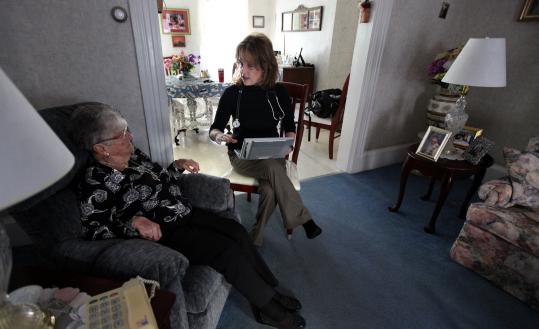
DeAnne Nignault of the Visiting Nurse Association of Boston, conducts a follow-up visit with patient Ann Boyle (Photo courtesy of Boston Globe/Pat Greenhouse)

Return to www.thinkhomecare.org.

Boston Globe: MA Lags on Assisted Living Homes

The Boston Globe reported on a Harvard Medical School study that revealed Massachusetts is below average when it comes to assisted living slots per resident over 65 years old.

The study’s lead author, and an assistant professor of health policy at Harvard, David Stevenson mentions the appeal of assisted living as well as home care:

“It comes down to what kind of long-term care we as a society think people should have access to,’’ Stevenson said. “Anyone who can avoid being in a nursing home does, whereas assisted living is hugely appealing to people, as are community-based and home services.’’

This quote, and the article in general, reiterates the importance of home care in that it is preferable to institutional care. Stories like this present the industry with an opportunity to remind policymakers that home care reaches the entire state without regard to income or location.

Return to www.thinkhomecare.org.

Work Continuing from EOHHS Summit

The Alliance is still accepting thoughts, suggestions and concerns from members to bring to the follow-up meetings to the Health and Human Services Summit.

In late November, Governor Deval Patrick and Health and Human Services Secretary Judy Ann Bigby convened a Massachusetts Human Services Summit to gather ideas and suggestions on how state government, and human service providers and organizations, could move forward in the current economic situation.

The event, held at UMass Boston, was attended by 300 providers, advocates, consumers and others, including Home Care Alliance staff and several Alliance members. Attendees were broken into three groups that focused on “Improving Access to Client Centered Services,” “Strengthening the Capacity of Human Service Organizations,” and “Sustaining a Quality Human Services Workforce.” Participants were charged with addressing these questions:

1.    What are the two to three major barriers (other than funding) that get in the way of working smarter and better?
2.    What can we do together to remove these barriers?
3.    What can state government and its private sector partners do to encourage and support innovation, both separately and in collaboration?

Alliance staff has been among those invited back to participate in follow-up workgroups who will continue to address these issues. For more info, visit the Human Services Summit website.

The Alliance would welcome any comments or suggestions on any of the above subjects so that we can be fully prepared to contribute. Workgroups will meet in mid-January. Please contact James Fuccione at the Alliance with any submissions.

Return to www.thinkhomecare.org.