Did You Hear About That? – October 2024

Federal Outlook

Presidential Candidate Stances on Health Care

As everyone is aware if they have watched any cable news recently, the presidential election is right around the corner. Today I would like to breakdown each candidate (the real candidates, VP Kamala Harris & Donald Trump) stances on health care and long-term care specifically. I would like to make it clear that HCA will not be endorsing any candidate for president and the point of this piece is educate on the candidates stances.

Long Term Care

Kamala Harris

  • Harris proposed a new plan to expand home care services under Medicare to help people with functional or cognitive impairments, and add a vision and hearing benefit to Medicare, paid for by expanding Medicare drug negotiations and other policies. When announcing the plan, Harris made it clear that this is aimed at the “sandwich generation”, the people who take care of aging parents as well as their own kids.
  • Proposes to partner with private technology companies to expand remote patient monitoring and telehealth and strengthen the home-care workforce.
  • Would most likely continue newly established minimum staffing requirements for nursing facilities, including other requirements to support nursing facility workers.
  • Would most likely follow in Biden administrations footsteps in promoting higher payment rates for home care workers (with pass-through, see 80/20 Medicaid rule), and reduce the time people wait for services.
  • Proposes working with Congress to end Medicaid estate recovery, a practice in which the state recoups the costs of Medicaid LTSS from the home and estates of deceased enrollees; or using administrative action to expand the circumstances in which families may be exempted.

Donald Trump

  • For the most part, Trump has not been public on his proposal for long term care. I would expect most of actions around long-term care to be centered around reducing regulations, unlike Kamala Harris.
  • Trump has proposed to protect seniors by “shifting resources back to at-home Senior Care,” addressing disincentives that contribute to workforce shortages, and supporting unpaid family caregivers through tax credits.
  • While President, issued regulations relaxing oversight for nursing facilities, including removing the requirement to employ an infection preventionist. 

Medicare

Kamala Harris

  • Like the current Biden-Harris Administration, Harris will likely continue to push to expand and fully fund Medicare.
  • During the 2019 Democratic presidential primary, supported a Medicare for all approach with a role for private insurance, however her campaign has since indicated she would not seek to advance Medicare for all as president and has supported the ACA and expansions to broaden coverage and make health care more affordable.
  • Biden-Harris administration proposes to “protect Medicare for future generations” in part by extending solvency of the Medicare Part A Trust Fund by raising Medicare taxes on high earners and closing tax loopholes and proposes to expand Medicare and Social Security (details not specified).
  • A Harris presidency could see a continued effort to expand telehealth access for Medicare services.
  • Will likely continue the Biden administration newly established staffing requirements for Medicare-certified nursing facilities.

Donald Trump

  • For a long time, the Republican party has pushed to cut Medicare spending. But this election cycle Trump and the Republican Party have publicly committed not to cut Medicare if Trump wins the White House, with the GOP’s platform stating the party will “fight for and protect Medicare with no cuts, including no changes to the retirement age.” Project 2025, which has been linked to Donald Trump, does include language about cutting Medicare funding.
  • While he has not called for cuts, the nonpartisan Committee for a Responsible Federal Budget projects that because of his proposal to cut taxes on social security benefits, it could result in Social Security and Medicare receiving $1.6 trillion less in revenue between 2026 and 2035 than if the current rules stayed in place, causing Medicare to become insolvent in 2030, six years sooner than currently projected.
  • Trump has proposed to protect seniors by “shifting resources back to at-home Senior Care,” addressing disincentives that contribute to workforce shortages, and supporting unpaid family caregivers through tax credits.
  • Trump is proposing reversing increases made to Medicare Part B premium but has not signaled how he would do it.
  • Trump is a firm believer in private companies’ involvement in health care. During his presidency he signed legislation that expanded treatment for substance use disorders and other mental health conditions and allowed Medicare Advantage plans to offer additional benefits for chronically ill enrollees. Trump could look to expand Medicare Advantage plans.

Medicaid

Kamala Harris

  • Harris would most likely continue the Bidens administrations 80-20 payment rule that was approved last year.
  • Like her stance on Medicare, Harris is a strong proponent for expanding Medicaid services. Harris, along with the Biden administration, have pushed to expand funding for Medicaid as a way to expand health coverage and improve continuity of coverage, reduce the rate and number of uninsured, expand access to care, and reduce health disparities.
  • Harris has touted the Biden-Harris administrations efforts to expand federal matching funds for priority areas under Medicaid, such as incentivizing states to expand Medicaid home and community-based services (HCBS)
  • She has signaled that she would work with Congress to try to extend Medicaid coverage in the 10 states that haven’t expanded it under the ACA. The Biden-Harris Administration enacted legislation to strengthen the ACA, including an additional fiscal incentive for states to adopt the ACA Medicaid expansion and temporary enhanced subsidies for Marketplace coverage.
  • Harris has championed Biden-Harris administration efforts to reduce maternal mortality and morbidity, including encouraging states to adopt the postpartum Medicaid coverage extension.
  • The Biden-Harris Administration withdrew demonstration waivers approved in the Trump Administration related to work requirements, and encouraged waivers to expand coverage, reduce health disparities, address the social determinants of health, and help individuals transition out of incarceration.

Donald Trump

  • During his last presidency, Trump approved waivers that included work requirements as a condition of Medicaid eligibility, premiums, and other eligibility restrictions. He also took administrative action to relax Medicaid managed care rules and increase eligibility verification requirements. 
  • Unlike Medicare, Trump has not said anything publicly about not making cuts to Medicaid.
  • Trump has previously proposed restructuring Medicaid financing into a block grant or a per capita cap as well as limiting Medicaid eligibility and benefits. Trump approved waivers that included work requirements as a condition of Medicaid eligibility, premiums, and other eligibility restrictions. 
  • Though he has not stated publicly, Trump could look to roll back the Biden 80/20 payment rule.
  • Project 2025 does talk about reforming financing for Medicaid in vague terms, calling for a more “balanced or blended” matching rate and the use of things like block grants, which essentially “cap” how much money can come to a state for Medicaid.

State Outlook

Ballot Question 1: Should the State Auditor Have Free Reign to Audit

While most of the media focus has been on the presidential and senate races across the country, back home in Massachusetts voters will need to consider their stance on key ballot question that would have an immense impact on the state legislature, its relationship with the executive branch, and the public.

Ballot Question 1: Do you approve of a law that would grant the state auditor the authority to audit the state legislature?

The state auditors’ job is to audit. Seems pretty straight forward! right??? Well, that depends on who you talk to. This all started back in March of 2023, when state auditor Diana DiZoglio unsuccessfully tried to audit the state legislature. DiZoglio, a former State Senator herself, stated that the reason why she wanted to audit the legislature was to shine a light on the historically dark under belly of the state legislature whose inner workings have been kept quiet, away from the public, behind closed doors. This audit would have covered budgetary, hiring, spending, and procurement information, information regarding active and pending legislation, the process for appointing committees, the adoption and suspension of legislative rules, and the policies and procedures of the Legislature.

DiZoglio was met with a brick wall of resistance from legislative leadership. House Speaker Rep. Ron Mariano and Senate President Karen Spilka, de facto leaders of the state legislature, refused to comply with the audit and did not turn over any information. They argue that her audit would violate checks and balances and is an overreach of the executive branch, some real old school James Madison arguments. DiZoglio didn’t take no for an answer and filed the current ballot question to the state Attorney General Andrea Campbell, to bring the audit to the public and leave it up to all of us to decide if she should be allowed to audit the legislature.

Recent polls show that 70% of voters plan to vote “Yes” on the ballot question. Many watchdog groups have pointed out that currently it is difficult to get any internal information about the legislature’s workings. Neither its committee votes nor hearing testimony are available to the public. There is also a lot of questions that have been raised recently on how legislative leadership uses fear and muscle to block legislative action and to hold tight control over committee seats and the budget process. Jonathan Cohn, policy director at Progressive Mass said that “we hold the status of being the only state where the governor’s office, the legislature, and the judiciary, all claim full exemption from the public records law,”.

While the polls show public support, there are people outside of the legislature that have raised concerns with audit. DiZoglio predecessor Suxanne Bump has been very vocal in saying that the her audit is going to far.  Bump said that the proposition went “beyond the bounds of legitimate government auditing.” An audit of the legislature, she said, would be inherently subjective, given there are no hard legal standards for how the legislature should legislate. “I’m sure, indeed, there are steps that could be taken to open up more of the legislative process to scrutiny, but this idea of auditing the deliberative processes of the legislature is not the way to go,” she said. “This is not a matter that’s going to be resolved at the ballot box.” Attorney General Campbell has also raised concerns about the audit. When DiZoglio said in August of 2023, that she would pursue litigation against the legislature, a move that would need the approval of Campbell, Campbell determined that DiZoglio lacks the legal authority to conduct such an audit and found no historical precedent for the type of audit she was seeking. She said that the litigation DiZoglio was pursuing was “not necessary or appropriate.” Campbell did allow Question 1 to make it onto this year’s ballot, but warned that constitutional limitations could affect how the ballot proposal would be applied if passed.

DiZoglio said that she and her staff have uncovered at least 117 instances of the Legislature being audited since the state auditor’s office was created in 1849. This stopped occurring in the early 1990s, she said.

Even If the proposition passes, primary legislative functions like voting and committee assignments would still remain exempt, according to analysis by the Tufts Center for State Policy Analysis. The Tufts report also emphasized that the legislature would have “a lot of leverage to resist investigations,” like refusing to consent. The vote would also likely face lawsuits to block the implementation of the authority if its is granted through the ballot question.

Rarely in modern times are citizens given the chance to truly influence how a legislature operates. If we believe in Lincolns message that our government should be “a government of the people, by the people, and for the people” then it is our responsibility to think critically about this and give our honest opinion how we feel about the current checks and balances in our state government.

Health Worker Shortages Forecast Thru 2028

Continued worker burnout and more demand for care from an aging population will drive health care workforce shortages into 2028, though with significant variations by state, according to a Mercer analysis. Mercers’ analysis shines a light on the acute need for more nurse practitioners, even in states like California and Texas that will have overall surpluses of health workers. The U.S. is expected to be short 100,000 health care workers by 2028, Mercer projects.

Mercer projects that Massachusetts will be amongst the states with the highest shortage of health care workers, with the analysis projecting that Massachusetts will be short over 12,000 workers (2.46%) by 2028. Only 13 states will be able to meet the demand for nursing aides, according to the projection. Home health and personal care workers, who represent nearly one-quarter of the health workforce, are projected to exceed demand nationally by almost 48,000 workers, though shortages are expected in states including North Carolina and New York. Massachusetts is expected to have a surplus of 5,000 home health and PCAs. This is due to recent large investments in home health/homemaker services over the last couple years, with rates for services increasing for the first time in 7 years.

With a rate review for some home health/homemaker services coming up in 2025, it is imperative that we push the Healey administration and the legislature to fully fund these services going forward, so that rates do not fall behind market demands, like they were for years before COVID.


The Rundown – July 2023

State Recap

HCA Provides Testimony at Elder Affairs Hearing

On June 19th, HCA provided verbal testimony (Add Testimony HERE) at a Massachusetts state Elder Affairs Committee Hearing. HCA provided testimony on H.640/S.397, An Act to Improve Infection Control in Massachusetts Home Care, which would direct EOHHS to establish a mandatory infection control training program for personal home care attendants and all home care employees.

During the hearing we made it clear that we do not support the bill and raised our concerns with bill as drafted. We explained that this bill would prove to be duplicative with existing infection control requirements established at the federal level and in ASAP contracts. In addition, we strongly encouraged that the bill be re-written so that the text clearly clarifies that home care agencies should be allowed to conduct the training, if infectious control training is required.

If you would like to submit your own written comments on the bill, testimony may be submitted to the Committee via email to committee joseph.russo@mahouse.gov and victoria.halal@masenate.gov.

Budget, What Budget? No Movement on State Budget

I think state legislators are taking The Kink’s song “Sunny Afternoon” a little too seriously. Once again state legislators failed to pass an annual state budget for FY24 by the June 30th deadline, resulting in the state legislator passing a supplemental budget to fund the government through July. This has become a common practice for the legislature, as they have not passed an annual budget on time since 2011. For reference of how long ago that was the last Harry Potter movie came out that year, Instagram had just come out, and Osama Bin Laden was killed. to summarize, THAT’S A LONG TIME AGO. Hell, I was still in school in 2011, I won’t say what level of school, but I’ll just say that I was 4 inches shorter in 2011 than I am now.

The legislature has taken a more relaxed approach in recent years with the budget usually being passed in mid-late July. Last year, the annual budget was not formally signed into law by then Governor Charlie Baker till July 28th. Legislators are still ironing out key discrepancy between the House proposal and the Senate proposals. At the rate they are at, I don’t expect a budget to be agreed and passed till late July at the earliest.  

Look Ahead

Joint Health Finance Committee to Hold Hearing on Rate Setting Legislation

The Joint Health Finance Committee plans to hold a hearing on Tuesday, July 25th, on numerous bills that pertain to home care services. One of the bills that is being considered is H.1195/S.755An Act Clarifying Rate Setting Processes for Home Health and Home Care Services. As a refresher, this bill would clarify the rate setting processes that are already in place for both home health and home care services. It would NOT set the rates or dictate the amount for future rates set by Mass Health and EOHHS. It does make the rate setting process more transparent and ensures rates set by the state follow the rate setting laws and reflect the actual operating costs incurred by home health and home care providers. In addition, it articulates the cost factors that should be included in the methodology and rate setting process including new regulatory costs and governmental mandates. Recent examples include changes in the state’s minimum wage, the Paid Family and Medical Leave Act, health insurance, employee benefits and training, and increased technology costs.

This bill has been a major focus of our advocacy efforts for the last couple years, and we would like everyone to provide testimony if possible. In all seriousness, it will only take 3 minutes of your time. I will draft a template for members to use to write their testimony to either send to the committee or to provide verbally on the day of. The more people the provide testimony, verbally or written, the stronger our voice. I will be there in person to speak to the committee on behalf of the association and if anyone would like to join me, please email me at hccollins@thinkhomecare.org.

House Proposes Nearly $700 Mil in Supplemental Spending (State House News)

House Democrats are preparing to bring forward a $693 million spending bill that would steer financial support to vulnerable hospitals, allow state energy regulators to update contracts related to a key hydroelectric transmission project in Quebec, and extend horse race simulcasting for another half-decade.

The House Ways and Means Committee on Wednesday morning opened a poll on a redrafted supplemental budget (H 3869), one day before the chamber is set to meet in its first formal session since April 26.

Of note, House Speaker Ron Mariano’s office said the bill calls for spending $180 million to support hospitals still facing pandemic-related impacts, including those that serve a high percentage of Medicaid patients.

Mariano’s office said the bill would also give the Department of Public Utilities the flexibility to approve amended transmission contracts related to the New England Clean Energy Connect (NECEC) project, which would carry hydroelectric power generated in Quebec through Maine to end points including Massachusetts.

Representatives on the House Ways and Means Committee were given until 11 a.m. Wednesday to indicate their support or opposition for the spending bill. The bill is a supplemental budget for fiscal year 2023, which ended June 30. House and Senate negotiators have not come to terms on a compromise annual budget for fiscal year 2024, which began July 1.

Federal Recap

CMS Proposes Massive Cuts to Home Health Payment Rates

On the last Friday of June, CMS published its FY 2024 home health proposed payment rule. First before I get into the proposed rule, I have to vent really quickly about how annoying it is that both federal agencies tend to release major regulations/proposed rules on Fridays, especially before holiday breaks. CMS released their proposal (though it was accidentally leaked early) in the afternoon on the FRIDAY BEFORE JULY 4th WEEKEND. Not only did this ruin my plan to leave work a little early to get a jumpstart of the long weekend, but it ruined the entire weekend because I had to read and analyze the entire proposal. Listen I understand that they do this because they want to bury proposals like this so that it doesn’t get major new coverage, but for us professionals, whose entire job are affected by these releases, it is such a slap in the face. I don’t pay my taxes that help to pay CMS staffs salaries for them to turn around and basically pull a beer out of my hand and throw a big regulatory rule at my face. It’s rude, inconsiderate, and ill argue it hurts the economy by keeping my hard-working (relative) people stuck inside reading, rather than out spending money at bars, restaurants and stores. It should be legally required that federal agencies have to release regulations/proposed rules on Mondays or at least 5 business days before a holiday break.

Alright, back to the proposal. CMS is proposing a 2.2% decrease aggregate home health payments, or an estimated $375 million less compared to 2023 levels. The proposed update would bump payments 2.7%, or $460 million, but that is completely undermined because home health agencies are being forced to absorb a 5.1% decrease, or a decrease of $870 million. As a refresher, last year CMS originally proposed a 7.85% permanent rate adjustment based on the conclusion that HHAs were overpaid in 2020 and 2021 due to provider behavior changes in coding and services provided. In the end, CMS only applied a 3.925% permanent rate reduction after objection from agencies and home care associations. At the time, CMS explained that the lower adjustment would be applied because “we recognize the potential hardship of implementing the full -7.85 percent permanent adjustment in a single year.” The 5.1% proposed rate reduction represents the remainder of the original 7.85% rate reduction that CMS calculated as warranted under its methodology for 2020 and 2021 along with an additional 1.636% for 2022, totaling 9.36% overall from the beginning of PDGM.  An early analysis indicates that the additional 2022 element to the proposed permanent adjustment is due to further visit decreases in a 30-day episode, particularly with therapy services. For an in-depth summary of the proposal rule, CLICK HERE.

CMS will accept comments on the proposed rule through Aug. 29. HCA will be submitting comments, and we strongly encourage members to submit comments as well. We will provide further updates as they develop on the proposed rule.

NAHC Files Lawsuit Against CMS and HHS

After the CMS proposed rule was released, The National Association for Home Care and Hospice (NAHC) filed a lawsuit against the Centers for Medicare and Medicaid Services (CMS) and the United States Department of Health and Human Services (HHS) challenging the validity of a change in Medicare home health payment that reduced rates by 3.925% in 2023 with significant additional cuts expected over the next several years. The lawsuit, which was filed in the District of Columbia, comes just a couple days after CMS released their proposed rule for 2024 which includes an addition additional 5.653% permanent rate cut in 2024.

In the lawsuit, NAHC argues that the methodology used to calculate the rates is flawed, and that the rate adjustment will worsen home care staffing shortages and patients’ access to care. In a statement released today by NAHC Until recently, nearly 3.5 million Medicare beneficiaries received home health services annually. Since the new payment model began in 2020, over 500,000 fewer Medicare patients have accessed home health services. According to a statement released by NAHC, they are seeking declaratory and injunctive relief including a reversal of the rate adjustments in the 2023 rule and requirement that Medicare implement the budget neutrality mandate consistent with the law. It should be noted that it could take months for the case to be heard with no timetable set. HCA will be closely following the court case and will provide updates as they unfold.

Look Ahead

With August recess right around the corner, July is usually a slower month where Capitol Hill wraps up last minute things before takin a month break. But not this year, Congress decided they wanted to set off some last second fireworks before everyone left. The big piece of legislation that everyone is talking about is the NDAA, the National Defense Authorization Act. The NDAA is a massive $886 billion must-pass bill that details the annual budget and expenditures of the U.S. Department of Defense. The NDAA is one of few pieces of legislation that usually passes with bipartisan support, and with minimal debate, but this year is very much different.

House Republicans have chosen the NDAA as the next battle ground in the culture war. Far Right Republicans have been adding countless poison pill amendments that risk driving away any chance of Democratic support. The most controversial amendment being Rep. Ronny Jackson (R-TX) proposal that would remove a Pentagon policy that allows service members to take up to three weeks of leave to travel out of state for an abortion and other “non-covered reproductive health care services.” The policy also states the Department of Defense will reimburse members for any expenses related to that travel. This rule was established in the wake of the Supreme Court decision that stripped abortion rights and left them up to individual states. Republicans argue that the new rule circumvents laws barring taxpayer money for the procedure in most cases, but language to undo this new policy could be a red line for Democrats. The abortion rule has been a major sticking point for Republicans in both the House and the Senate. In the Senate Sen. Tommy Tuberville (R-AL), who looks like the human version of Squidward, has been holding up high level defense appointments until the rule is taken out, leaving many key positions unfilled.

Other poison pill provisions revolve around Ukraine, NATO, sea-launched cruise missiles, and Buy American provisions. House Democratic leadership has signaled that if Republicans choose to move forward with any or some of these amendments (especially the abortion proposal) they would pull their support for the bill. that would leave Republicans with little wiggle room to pass the bill.

In the end the NDAA will be the central focus till they leave for August recess, with the Senate needing to pass the NDAA once it finally moves through the House. So there is still an opportunity for these people to say stupid stuff, like that being a white nationalists doesn’t make you racists, that will get everyone on Twitter and Thread (what ever that is) into a frenzy.

Further Improvements to Find-An-Agency Search

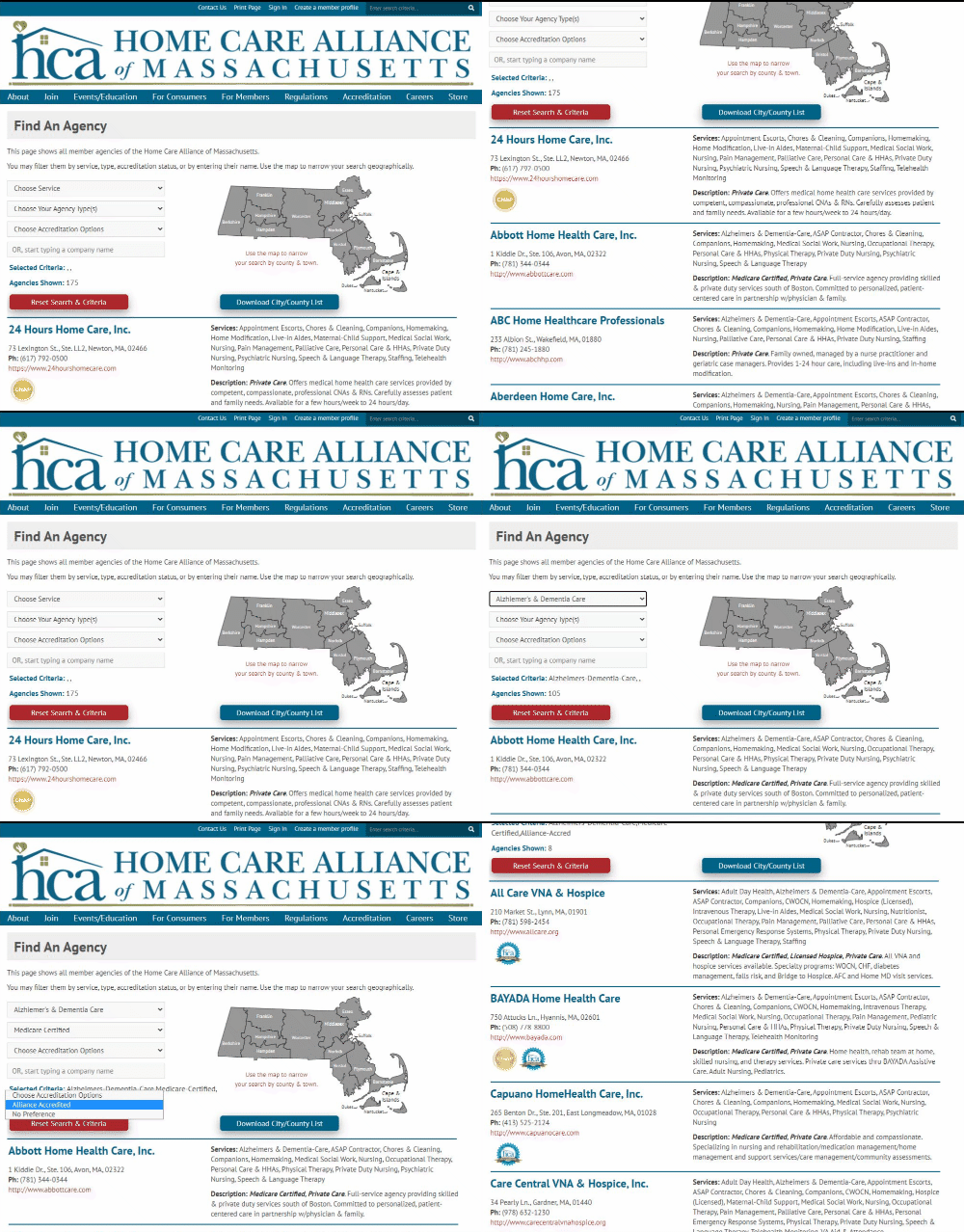
The Alliance’s Find-An-Agency search is now mobile-responsive and has several other enhancements. Check it out at http://www.thinkhomecare.org/agencies.

In March 2021, the Alliance re-launched its Find an Agency Search to help families connect with home care, home health, and hospice agencies. Last week, we gave the system an upgrade with two important new features:

  1. The search automatically reformats to all devices, including phones and tablets.
  2. Clicking on an agency’s name opens its full profile.

Try it yourself at: www.thinkhomecare.org/page/agencies.

The search is fast and intuitive, allowing users to quickly filter agencies by geography, services offered, agency type, and accreditation status (or any combination of those factors). Alternatively, users looking for a specific agency may search for it by name.

Results update immediately, as users select criteria, and the search counts the number of agencies shown at any given time.

To test the search for yourself, visit www.thinkhomecare.org/agencies. Questions? Contact me at tmeyer@thinkhomcare.org.

Talking Home Care: Serving Clients & Protecting Staff During the Pandemic

Cheryl Rumley—founder and president of Apex Homecare—offers a powerful, first-person account of her experience running an agency during the COVID-19 Pandemic.

For the 16th episode of Talking Home Care, Pat talks with Cheryl Rumley, founder and president of Apex Homecare in Springfield, Massachusetts. Cheryl offers a powerful, first-person account of her experience running an agency during the pandemic. Like many owners, Cheryl had to figure out how to care for her clients while also looking out for her employees’ safety and need to care for their own families.

They also discuss Cheryl’s connection to the 1918 Spanish Flu Pandemic and Governor Charlie Baker’s leadership during the last 18 months.

You may listen to the podcast by clicking any of the platform images above, clicking “play,” or downloading it directly (Length: 21 minutes; Size: 15 MB).

Cheryl Rumley and Pat Kelleher

If you enjoy the podcast, please subscribe and give us a five-star review so others can find it.

Return to www.thinkhomecare.org.

Re-Launched & Improved Online Agency Search

Redesigned from scratch, the Alliance’s new Find an Agency Search is designed to connect families and referral sources with home care agencies quickly and easily.

Redesigned from scratch, the Alliance’s new Find an Agency Search is designed to connect families and referral sources with home care agencies quickly and easily.

The new search is fast and intuitive, allowing users to quickly filter agencies by geography, services offered, agency type, and accreditation status (or any combination of those factors). Alternatively, users looking for a specific agency may search for it by name.

Results update immediately, as users select criteria, and the search counts the number of agencies shown at any given time. Though designed for desktop use, it also works on mobile platforms.

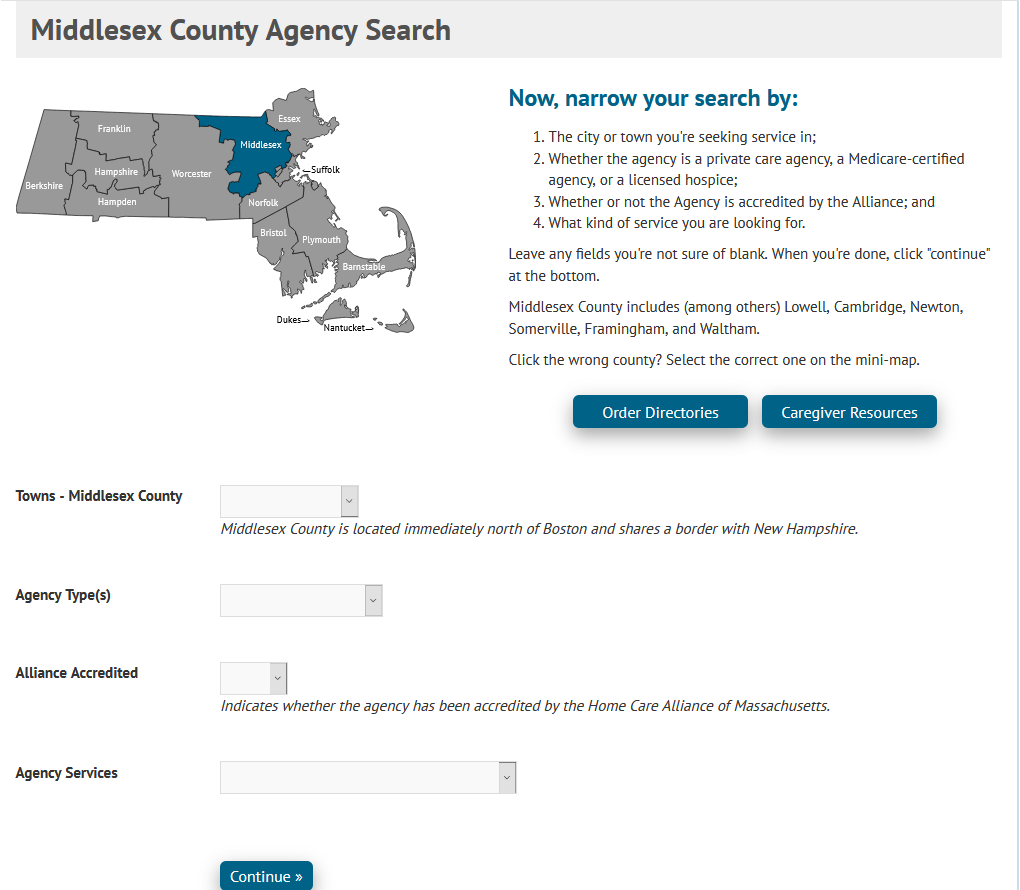
This is a massive improvement over the old search in both design and function, particularly in terms of how it displays search results.

Old Search

New Search

To test the search for yourself, visit www.thinkhomecare.org/agencies. Questions? Contact me at tmeyer@thinkhomcare.org.

Black History Month Interviews: Felicia Moore of Neighborhood Home Care

During Black History Month, we’re honored to share stories from members of color. That is why it was my privilege to talk with Felicia Moore of Neighborhood Home Care.

Moving from Mississippi to Massachusetts would be a culture shock for anyone. However, Felicia Moore of Neighborhood Home Care has used that experience to educate and serve communities in which healthcare can be hard to find and is often misunderstood.

During Black History Month, the Home Care Alliance of Massachusetts is honored to share stories from members of color who own and operate home care agencies in Massachusetts. That is why it was my privilege to talk with Felicia. She is passionate about providing healthcare and education, especially to those in underserved communities. You can see it through the way she speaks and reminisces about her experiences.

The Alliance’s Michelle Burton and Neighborhood Home Care’s Felicia Moore (Full Interview)

Felicia shares what drew her to home care, how it has shaped her journey, and what differentiates her agency from others. In the clips below, she shares with us a client story that has stuck with her, as well as on the importance of trust in forming connections with clients in their homes.

Stay tuned for more interviews this week.


Moore: “I did not get here by myself.”
Moore on Inspiring Others
Moore on the Real Standard of Success

Return to www.thinkhomecare.org.

Talking Home Care: Employment Law During a Pandemic with Angelo Spinola

Veteran litigator Angelo Spinola answers questions about how agencies are rising to meet the biggest employment law challenges they face, including those posed by the COVID-19 Pandemic.

Angelo Spinola and Pat Kelleher

Even in the best of times, human resource issues pose an enormous challenge to home care agencies. But when responding to a global pandemic, many agencies found themselves scrambling to address new questions. How do you help employees with childcare challenges? How do you handle on-boarding (and firing) when everyone is working off-site? Who pays for COVID tests, and how should time spent getting the test be compensated? Can employers require vaccinations?

For the 15th episode of Talking Home Care, Pat speaks with Angelo Spinola of Littler Mendelson, a leading employment law litigator about these and other issues. They also discuss the subscription-based, on-line Home Care Toolkit Littler developed and constantly updates. The Toolkit gives agencies access to a world-class HR resource, policy manual, and document library that’s like adding an expert to your staff.

The Home Care Alliance of Massachusetts has negotiated a special agreement with Littler to give our members access to the Toolkit at a great price, with a portion of all sales supporting the Alliance! To learn more or to order your subscription, contact Melissa Mann at MMann@littler.com or (404)760-3928.

You may listen to the podcast by clicking any of the platform images above, clicking “play,” or downloading it directly (Length: 40 minutes; Size: 29 MB).

If you enjoy the podcast, please subscribe and give us a five-star review so others can find it.

Return to www.thinkhomecare.org.

Talking Home Care: Home Care Heroes During a Pandemic

Front-line heroes share their stories about overcoming the challenges posed by the COVID-19 Pandemic.

The COVID-19 Pandemic has created huge challenges to healthcare systems across the globe, including here in Massachusetts. As part of National Home Care and Hospice Month, we collected first-hand stories from our members about the front-line challenges they faced, and how they overcame them.

For the 14th episode of Talking Home Care, we’ve collected these stories into a single podcast. They are introduced by Alliance Executive Director Pat Kelleher and are read by drama students at Winthrop Middle School.

You may listen to the podcast by clicking any of the platform images above, clicking “play,” or downloading it directly (Length: 41 minutes; Size: 29 MB).

If you enjoy the podcast, please subscribe and give us a five-star review so others can find it.

Return to www.thinkhomecare.org.

CMS Finally Releases Updated ABN Form!

Providers will need to use the renewed ABN form starting this August.

CMS just released the long-awaited Advance Beneficiary Notice of Noncoverage (ABN). The current ABN form expired in March 2020, so CMS instructed providers to continue using the expired form, since the form’s renewal was on hold at the Office of Management and Budget during the Public Health Emergency. Yesterday, CMS posted the updated ABN Form CMS-R-131 and form instructions (see the Downloads section at the bottom of the linked page).

The renewed form (with the expiration date of June 30, 2023) will be mandatory beginning August 31, 2020.  The ABN is issued by home health and hospice providers to Medicare beneficiaries in situations where Medicare payment is expected to be denied. The ABN is issued in order to transfer potential financial liability to the Medicare beneficiary in certain instances. Guidelines for issuing the ABN can be found beginning in Section 50 in the Medicare Claims Processing Manual, 100-4, Chapter 30 (PDF).

COVID-19 Resources for Home Care & Hospice Agencies

To ensure members have access to information they can trust, the Alliance has put together a COVID-19 Resource Page, linking to federal, state, and other essential sources.

COVID-19

To ensure members have access to information they can trust, the Alliance has put together a COVID-19 Resource Page linking to federal, state, and other essential sources.

We’ll update it as new information becomes available.

Return to www.thinkhomecare.org.