Statement on Boston Globe Article: A Stranger in the House

Boston, MA – The Home Care Alliance of Massachusetts issued the following statement in response to the two-part Boston Globe article titled “A Stranger in the House” printed September 16th and 17th:

The Home Care Alliance and its members have a zero-tolerance policy when it comes to patient abuse. Over many years we have worked with the Department of Public Health, Elder Affairs and Health and Human services to address issues of elder abuse and billing fraud. Our members take very seriously the responsibility of ensuring the safety and quality of care being delivered to their clients.

These Boston Globe articles confusingly lump three different classes of workers together: personal care attendants employed directly by consumers in the PCA program, aides hired through a home care agency, and workers hired directly by consumers in the underground marketplace.

While the article cites 20 cases of agency-hired workers committing abhorrent crimes in ‘recent years,’ it fails to contextualize the fact that home care agencies have employed over 75,000 workers and delivered care to more than 600,000 elders in the past five years.

We have long advocated for the Commonwealth to develop a licensure process and we support state legislation (H.344) which we believe would enact baseline consumer protection standards for private pay home care agencies. We also advocated for recently enacted legislation to license certified home health agencies.

In failing to adequately explain the structure of the home care system in Massachusetts, readers are left confused and scared. At a time when aging-in-place is a statewide priority, we should be working on solutions that expand access to these services and protects consumers in the setting that they prefer: home.

About the Home Care Alliance of Massachusetts:

With a mission to unite people and organizations to advance community health through care and services in the home, the Home Care Alliance of Massachusetts is a non-profit trade association and advocacy group providing representation, education, communication, advocacy and – ultimately – a voice for the state’s home health industry. Founded in 1969, the Alliance has grown to represent more than 160 home care and home health agencies across the state. For more information, visit www.thinkhomecare.org.


Talking Home Care: Ryan McEniff on Running a Private Care Agency

Minute Women Home Care’s Ryan McEniff joins us to talk about the challenges of running a private home care agency in today’s economy and how families can ensure they get the best care.

Ryan McEniff of Minute Women
Ryan McEniff

How did a “big, six-foot-six, burly guy” become the owner of Minute Women Home Care? For the seventh episode of the Talking Home Care podcast, Pat Kelleher talks with Ryan McEniff about what it takes to run a successful private home care agency. Topics include:

  • Ryan’s personal story about entering the industry;
  • The challenges (and opportunities) of transitioning from family to paid home care;
  • How home care can restore clients’ work/life balance;
  • Whether home care can remain affordable to middle-class families in a bustling economy;
  • Why finding (and keeping) the best staff is sometimes a bigger challenge than attracting clients;
  • Going the extra mile to protect clients with national background checks;
  • The single most important question all families should ask when choosing an agency for their loved ones (jump ahead to 34’35” to find out); and
  • Ryan’s own podcast, The Caregiver’s Toolbox (expect Pat on an upcoming episode).


You may listen to the podcast by clicking the play button above, downloading it directly, or subscribing through iTunes or Google Play. (Length: 37 minutes; Size: 18 MB). If you enjoyed it, please give us a five-star review so others can find it as well.

Host: Patricia Kelleher is the Executive Director of the Home Care Alliance of Massachusetts.

GuestRyan McEniff has been the owner of Minute Women Home Care since 2013. He became passionate about home care when his mother needed care while battling cancer. He is also a Certified Dementia Practitioner and the host of The Caregiver’s Toolbox podcast.


Talking Home Care LogoDon’t want to miss the next episode of Talking Home Care? Subscribe through iTunes, Google Play, or accessing its feed directly.

Return to www.thinkhomecare.org.

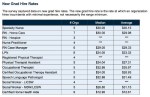
Take the Guess-Work Out of Employee Compensation with Our 2018 Survey

This exhaustive, timely guide gives you all the tools to ensure you make informed decisions about hiring, keeping, and compensating home health staff in Massachusetts.

The 2018 Compensation Survey is an indispensable tool for c-suite staff and HR managers, proving a quick and accurate reference of industry pay standards for your employees.

The survey contains information about prevailing pay and benefits for the full range of positions in home care agencies. It lists pay and benefits figures for dozens of positions, including: executive, administrative, supervisory, care giving, and clerical positions.

The survey is available for purchase on our website for $400 for members, $500 for non-members (members who participated in the survey should have received coupon codes with an additional discount). Make sure you have the tools you need to make the best decisions for you and your staff.

The full survey is over 200 pages. To get a sense of the available information, click the sample pages above.

Return to www.thinkhomecare.org.

Talking Home Care: Eric Scharber on Workforce Challenges: “Whoever Has the Talent Is Going to Win”

Exact Recruiting’s Eric Scharber joins us for a discussion about how to recruit and retain the best workforce from every age-group.

Eric Scharber of Exact Recruiting
Eric Scharber

For the sixth episode of the Talking Home Care podcast, Pat Kelleher talks recruiting and retention with Eric Scharber, a principal of Exact Recruiting. Topics include:

  • The advantages to employers of focusing on retention as much as recruiting
  • How small changes in retention can make a real difference to an agency’s bottom line
  • Why offering staff development is sometimes more important than pay increases
  • The challenges (and opportunities) of hiring Millennials
  • How to get graduating nurses and therapists to consider careers in home care and hospice
  • The specific challenges of retaining non-medical caregivers such as CNAs and home health aides

You may listen to the podcast by clicking the play button above, downloading it directly, or subscribing through iTunes or Google Play. (Length: 28’30”; Size: 15 MB).

Host: Patricia Kelleher is the Executive Director of the Home Care Alliance of Massachusetts.

GuestEric Scharber is a principal at Exact Recruiting, a Simione Talent Solution, where he leads talent acquisition and employee retention for the home care and hospice industry. He oversees executive search and non-executive recruiting services, as well as recruitment process outsourcing, compensation analysis, and employee satisfaction survey services.

Talking Home Care LogoDon’t want to miss the next episode of Talking Home Care? Subscribe through iTunes, Google Play, or enter the following in your podcast app: https://thinkhomecare.wordpress.com/category/talking-home-care-podcast/feed/

Return to www.thinkhomecare.org.

Advocacy Alert: Email Senators Urging Support for HCA Budget Priorities

Last week, the Massachusetts Senate Ways and Means committee released its fiscal year 2019 state budget totaling $41.4 billion dollars. Senators had a deadline of Monday to file amendments to the bill, and it will be debated next week. Three Alliance priorities have been filed as amendments. Below are brief descriptions of each, with a link to send a pre-drafted email to your state legislator. The Alliance encourages you to send an email for all three amendments.

Amendment #589: EMAC Assessment Hardship Waiver:

  • This amendment would authorize the Department of Unemployment Assistance to establish a hardship waiver for employers that provide services to EOHHS/EOEA clients, or services in the public interest, who have a financial burden as a result of their EMAC tax liability. Take Action.

Amendment #560: Enough Pay to Stay Amendment:

  • This amendment would provide $28.8 million in increased funding for the State’s home care system front-line workforce. Take Action.

Amendment #620: Continuous Skilled Nursing Funding

  • This amendment would provide a $16 million increase for the Commonwealth’s Continuous Skilled Nursing program to address the workforce shortage resulting in unfilled service hours. Take Action.

Celebrate Nurses Week

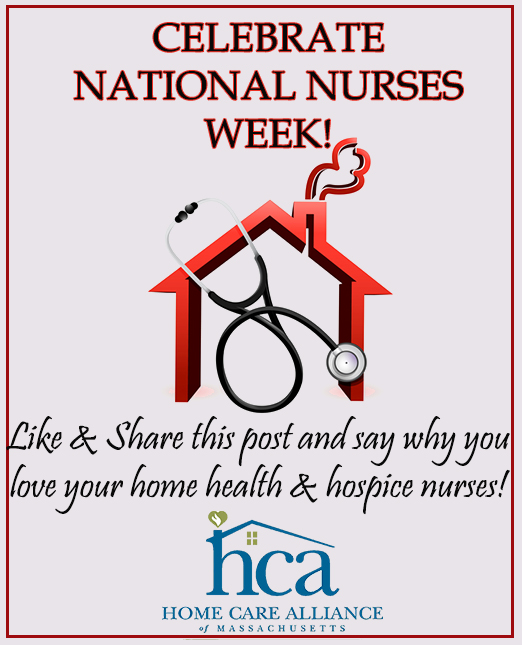
Next week is National Nurses week. It is a time to celebrate the dedication, caring and overall contributions of those who choose nursing as their profession.

The Home Care Alliance would like to share your nursing human interest stories next week across our various social media platforms, whether it’s a shout out to a team or a staff member.

Email Megan Fournier at mfournier@thinkhomecare.org to tell us why you love home care & hospice nurses – OR – share our post below and comment why!

Celebrate Nurses Week 2

This Guide Has All You Need to Find Home Care in Massachusetts

Now in its 12th edition, the Guides to Private Home Care Services have connected tens of thousands of families with the home care agencies that can help them care for their families and loved ones.

Need a primer on what home care can do? Don’t know how to pay for it? Don’t know how to select an agency, whom to trust, or what agencies are available in your are? This free directory answers all of your questions.

Click the images above to order.


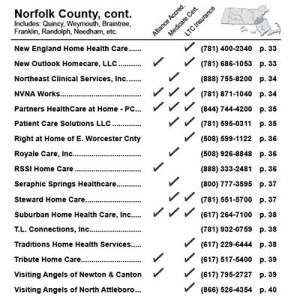
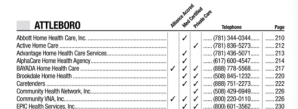
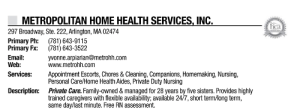
Screenshots from the directories.

Looking for something more comprehensive? the Resource Directory is intended for professionals and others who make regular referrals to home care, the Private Care Guides are designed for consumers and are always available at no charge.

Return to www.thinkhomecare.org.

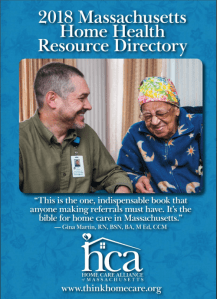
Just Published: 2018 Resource Directories!

This is the one, indispensable book that anyone making referrals must have. It’s the bible for home care in Massachusetts. — Gina Martin, RN, CCM

Thousands of copies of the the Alliance’s home care referral directory have already been shipped to every case manager, hospital, COA, state legislator, and GCMs in Massachusetts.

Need an copy? They’re available for purchase on our website, with free shipping (as always).

Alternatively, you can also use the Digital Edition of the directory, as well as our online Find an Agency search.


Return to www.thinkhomecare.org.

Talking Home Care Episode 5: Barbara Citarella on Emergency Preparedness

Pat Kelleher talks emergency and disaster preparedness with Barbara Citarella, president of RBC Limited Healthcare & Management Consultants.

Barbara Citarella
Barbara Citarella

For the fifth episode of Talking Home Care, Pat Kelleher talks emergency and disaster preparedness with Barbara Citarella, president of RBC Limited Healthcare & Management Consultants. Topics include:

  • CMS’s 2016 preparedness operations requirements;
  • The unique challenges home care agencies face during emergencies (as well as their unique capabilities);
  • Lessons agencies can learn from recent natural disasters;
  • Home care’s ability to provide surge capacity for other health providers;
  • The biggest obstacles agencies face in implementing a disaster plan; and
  • Resources for agencies who wish to become better prepared.

You may listen to the podcast by clicking the play button above, downloading it directly, or subscribing through iTunes or Google Play. (Length: 32’45”; Size: 17 MB).

Links/Action:

Talking Home Care LogoHost: Patricia Kelleher is the Executive Director of the Home Care Alliance of Massachusetts.

Guest: Barbara Citarella is the president and founder of RBC Limited Healthcare and Management Consultants, a national leader in the home health and hospice industry in addition to disaster planning. As the only recognized expert in the area of home care and hospice disaster planning, she specializes in emergency disaster planning, bioterrorism, health care development and operations.  She provides education to law enforcement and government agencies, health care providers, private sector, first responders, national and state associations in all aspects of disaster preparedness.

Don’t want to miss the next episode of Talking Home Care? Subscribe through iTunes, Google Play, or enter the following in your podcast app: https://thinkhomecare.wordpress.com/category/talking-home-care-podcast/feed/

Return to www.thinkhomecare.org.

MA Legislative/Regulatory Preview for 2018

On Wednesday January 3rd , the Massachusetts Legislature returned for the second year of its two-year session. After a seven-week recess, the body is looking at a traditionally busier second half than the first. The nearly 170 bills that passed in 2017 marked the lowest total in twenty years.

Lawmakers have until July 31 to complete all substantial legislative debate. In addition, all 200 members are up for election in 2018, which is expected to be a distraction from normal legislative work as a result of a polarized political landscape. Here’s what the Alliance will be focused on in 2018:

Workforce Issues:

Prior to the Holiday break, the Alliance met with its ‘Enough Pay to Stay’ partners to strategize coordinated efforts to attain wage relief for direct care workers and ASAP case managers. The coalition has pending legislation which would take steps toward this initiative, but we will pursue other legislative vehicles to fight for our workforce.

Worker Registry:

In November, Governor Baker signed into law the Home Care Worker Registry. This law will establish a worker registry that requires agencies contracting with ASAPs to submit workers’ private information to the state. The law is enacted and subject to regulations. The Alliance and its partners are in active communication regarding next steps toward protecting our members and their workers’ rights.

Licensure:

The FY 2018 State Budget included language that will establish a licensure process for home health agencies providing skilled services. It is unclear at this point when the process to promulgate regulations will begin, but the Alliance will be providing input to the Department of Public Health as these parameters are developed. In addition, Alliance-sponsored legislation that would license private care agencies is still making its way through the legislative process. Under procedural rules, the legislature has until February to report legislation out of committee. The Alliance will continue to advocate for passage of this legislation.

Continuous Skilled Nursing:

In late 2017, MassHealth announced two rate increases for the Continuous Skilled Nursing (CSN) program that totaled nearly 11 million. This was welcomed news, but there remains work to be done. The CSN provider/parent coalition will continue to advocate for the CSN Bill of Rights legislation that would mandate bi-annual reviews of the workforce to ensure safeguards against future crises.

MassHealth Rates:

The Alliance has been informed that MassHealth will conduct a long-overdue review of rates for per-visit nursing, therapies, and home health aide services.  The Alliance will be working to gather data to demonstrate that the current low rates are interfering with agencies’ ability to attract and retain enough workers to meet the demand for services.

MassHealth Reorganization:

MassHealth’s initiative to enroll the majority of members into managed care programs this coming spring will dramatically change the way MassHealth members access home health services, and disrupt many existing provider referral relationships.  The Alliance will continue to work to ensure that MassHealth members retain access to needed home health services, and that agencies are adequately reimbursed for those services.

House of Representative Health Care Bill:

Late last year the Senate passed a health care cost containment bill aimed at curbing costs while maintaining access. It has long been rumored that the House will be embarking on similar initiatives. Though the details are scarce, this legislation could be a vehicle for many of the Alliances priorities in 2018 and we will continue to advocate where necessary.

If you have any questions about the year ahead for advocacy or would like to get involved, reach out to Jake Krilovich, the Alliance’s Director of Legislative and Public Affairs.